
What if the persistent feeling of being "unplugged" isn't a modern malady, but a quiet call from a lineage waiting to be remembered? For many, the desire to return to indigenous roots is met with a paralyzing fear of doing it wrong or a confusion between cultural pride and religious dogma. This African spirituality for beginners guide is written for those who feel the pull of the past but need a grounded, respectful way to start. It's natural to seek spiritual safety while looking for a path that feels both ancient and relevant to your life today.
We're here to offer a steady hand as you reclaim your heritage with confidence. You'll discover how to move past the noise and focus on the foundational principles that define our collective wisdom. We'll explore the vital concept of Asè, the enduring presence of the Ancestors, and the practical steps you can take to begin a daily practice right where you are. You don't need to be an expert to belong to your own history; you simply need the willingness to listen and the structure to grow. Welcome to a space where your reconnection is sacred, intentional, and supported.
Key Takeaways
- Discover how African spirituality functions as a holistic worldview where the sacred and secular flow together as one inseparable reality.
- Understand the vital pillars of indigenous belief, including the presence of the Supreme Creator and the spiritual power found within the natural world.
- Learn why establishing a deep foundation of knowledge is a necessary first step before exploring complex rituals or the vocational path of initiation.
- Follow this African spirituality for beginners guide to begin your reconnection through simple, intentional acts like silence and observing the rhythms of nature.
- Identify a clear roadmap for your long-term growth by moving through structured levels of study that honor both ancient tradition and your personal journey.
Understanding the Essence: What is African Spirituality?
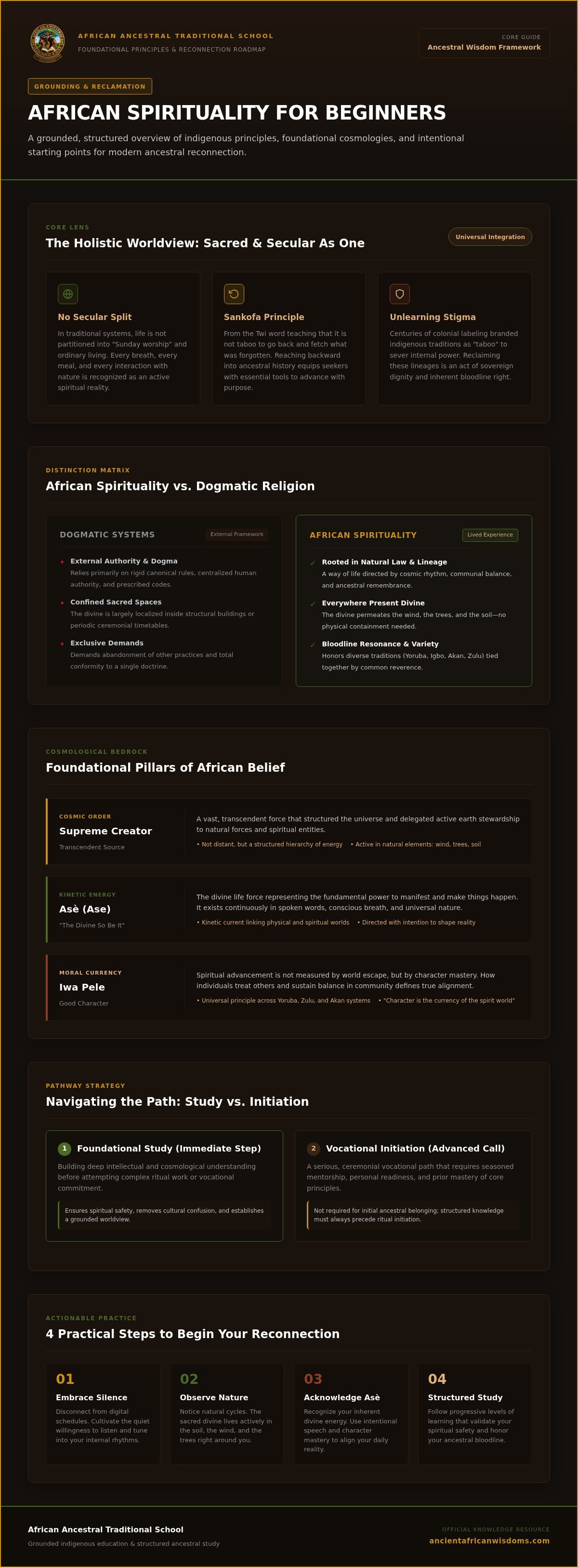
African spirituality isn't a hobby or a set of Sunday rituals. It's a lens through which you see the entire world. In many traditional African religions, there's no distinction between the sacred and the secular. Every breath, every meal, and every interaction with nature is a spiritual act. This holistic worldview reminds us that we're never truly alone or disconnected from the divine force that moves through all things. It's a continuous flow of energy that links the physical world to the spiritual one, making every moment an opportunity for connection.
For many people starting this journey, the biggest hurdle isn't learning new facts. It's unlearning the stigma. Centuries of colonial influence labeled indigenous practices as "taboo" or "superstitious" to intentionally disconnect people from their internal power. Reclaiming these truths is an act of liberation. It's your inherent right as a member of the diaspora to walk the path your ancestors paved. This African spirituality for beginners guide serves as a bridge to help you cross back into that ancestral territory with dignity and quiet confidence.
Reclaiming Ancient Insights for Modern Life
Modern life often leaves us feeling fragmented and anxious. We're tethered to screens and schedules that ignore our internal rhythms. Ancient wisdom offers a grounded remedy through the concept of "Sankofa." This Twi word teaches us that it isn't taboo to go back and fetch what we've forgotten. By reaching back into your history, you find the tools to move forward with purpose. The African Ancestral Traditional School provides a structured environment for this reclamation. It helps seekers navigate their personal growth through levels of learning that feel both ancient and relevant to the challenges of today.
The Distinction Between Spirituality and Religion
While religion often relies on rigid dogma and external authority, African spirituality is a lived experience rooted in natural law and lineage. It's a way of life rather than a list of rules to follow. You don't have to abandon your current faith to honor your heritage. Instead, you're invited to deepen your understanding of who you are. Whether you're drawn to the complex systems of the Yoruba, the deep traditions of the Igbo, or the wisdom of the Akan, you'll find a common thread of reverence. This diversity is a strength. It allows you to find the specific rhythm that resonates with your own bloodline while validating the spiritual safety you deserve.
The Foundational Pillars of African Indigenous Beliefs
Every spiritual system has its bedrock. In our African traditions, these pillars provide a steady framework for understanding your place in the cosmos. Most systems recognize a Supreme Creator, a vast and transcendent force that delegated the management of the earth to various spirits and natural forces. This hierarchy isn't about distance, but about a structured flow of energy. You can see this reflected in the holistic nature of African spirituality, where the divine isn't hidden in a building but is actively present in the wind, the trees, and the soil beneath your feet.
The ultimate goal of this path isn't to escape the world, but to master your character within it. Concepts like Iwa Pele (good character) remind us that spiritual growth is measured by how we treat others and how we maintain balance in our communities. These principles are universal across the continent, offering a consistent African spirituality for beginners guide regardless of whether your specific lineage traces back to the Yoruba, the Zulu, or the Akan. Character is the currency of the spirit world.
The Concept of Asè: The Divine Life Force
At the heart of everything is Asè. Understanding asè meaning is essential because it represents the power to make things happen. It's the divine "so be it" that exists in your words, your breath, and the natural world. Asè is the kinetic energy of the universe that connects all living things. When you speak with intention or perform a ritual, you're directing this flow of energy to manifest change. It's a reminder that you possess an inherent power to shape your reality through alignment with natural laws. If you're ready to deepen this connection, exploring our ancestral spiritual teachings can help you learn to harness this force with integrity.
Ancestor Veneration: The Bridge Between Worlds
One of the most misunderstood aspects of our culture is our relationship with those who came before us. It's vital to distinguish between worship and veneration. We don't worship ancestors as gods; instead, we honor them as the foundational roots of our existence. For those exploring ancestral veneration for the African diaspora, this practice is about reclaiming a broken link. Think of your ancestors as your spiritual legal team in the unseen realm. They advocate for your well-being and provide guidance because they have a direct stake in your success. By building a bridge to them, you're never walking your path alone.
Navigating the Path: Study vs. Initiation
When you feel the call of your ancestors, it's common to want to jump straight into the deepest part of the ocean. Many seekers believe they must undergo a complex initiation ceremony just to begin their journey. However, this African spirituality for beginners guide emphasizes that knowledge is your first and most powerful protection. Jumping into rituals without understanding the history or culture behind them can lead to confusion or, in some cases, exploitation by unvetted groups. You don't need a title to start honoring your roots; you need a foundation.
The diverse indigenous African belief systems offer a rich tapestry of wisdom that requires patience to unravel. Learning the "why" before the "how" ensures that your practice is grounded in authenticity rather than performance. At the African Ancestral Traditional School, we focus exclusively on digital education and ancestral teachings. We don't offer in-person initiation ceremonies or psychic readings. Instead, we provide the intellectual and spiritual tools you need to build a safe, sustainable practice from the comfort of your own home.
The Importance of Structured Spiritual Learning
Approaching your heritage without a roadmap often leads to the "spiritual tourist" trap, where you collect disconnected rituals without understanding their source. A structured curriculum helps you avoid this by moving you through intentional levels of learning. By building a solid base of core concepts, you ensure that advanced rituals actually mean something when you eventually reach them. Our community access further supports this growth, offering a space where you can ask questions and find belonging among others who are also walking the path of reclamation.
Reclaiming Identity Through Lineage and Heritage
Your connection to the continent isn't just historical; it's written in your spiritual DNA. For the diaspora, studying tradition is a profound way to heal the trauma of lost identity and displaced heritage. It's an invitation to look at your own family history as your very first textbook. Start by researching the names of those who came before you and documenting the stories that have survived the generations. This simple act of remembrance is the first step of study, proving that the wisdom you seek isn't outside of you, but waiting to be awakened within your own bloodline.
Practical Steps to Begin Your Ancestral Journey
You don't need an elaborate shrine or a secret password to begin this work. The most profound shift happens internally through the simple power of your intention. This African spirituality for beginners guide invites you to start exactly where you are, using the tools you already possess. Before you buy a single item, begin by practicing observation. Spend five minutes in total silence each morning. Take a slow walk through a local park and notice how the wind moves the leaves. These low-stakes actions help you tune your internal frequency to the subtle whispers of your lineage. As you follow this African spirituality for beginners guide, remember that your ancestors are already waiting for you to reach out; they've never left your side.
Consistency is the heartbeat of spiritual growth. It's much better to spend three minutes in quiet reflection every day than to perform a massive ritual once a year. When you show up regularly, you build trust with yourself and with the spirits who guide you. If you're looking for a structured way to maintain this momentum, you can explore our ancestral spiritual teachings to find a rhythm that fits your modern life. Each small step you take creates a stronger bridge between your current reality and your historical roots.
Creating a Sacred Space: The Ancestral Altar
A physical space in your home acts as a dedicated portal for focused communication. You can find detailed setup instructions in our resource on African ancestral rituals online, but the basics are quite simple. Find a clean, quiet surface. Place a clear glass of fresh water, a single white candle, and photos or mementos of your loved ones who have passed. This altar isn't an object of worship; it's a spiritual "telephone" that helps you concentrate your energy and direct your thoughts toward your lineage with clarity and respect.
Developing a Daily Practice of Veneration
Veneration is the act of acknowledging the continuous presence and influence of those who came before us. Start your day by speaking to your ancestors directly. Your spoken words carry Asè, the power to manifest change in your reality. Tell them about your goals, ask for their protection, or simply thank them for the life you now carry. Offering a fresh glass of cool water is a traditional way to provide refreshment to their spirits. This simple, daily act of service reinforces the bond between the living and the dead, ensuring that the wisdom of the past remains a living force in your present.
Advancing Your Knowledge: The Path Forward
The journey that begins with a simple glass of water and a quiet prayer eventually leads to a deeper desire for understanding. You've moved from curiosity to practice, but the path of reclamation often requires a more structured approach to truly flourish. Transitioning from "reading about" these traditions to "living" them is where the real transformation occurs. This African spirituality for beginners guide has provided the initial spark; now, you have the opportunity to fan that spark into a steady, enduring flame through intentional study. When you commit to a structured path, you aren't just learning a subject. You're realigning your life with the rhythms of your lineage and the natural laws that govern our existence.
The Value of a Guided Curriculum and Community
In a digital age, it's easy to get lost in a sea of conflicting information and unverified claims. A guided curriculum acts as a protective shield, ensuring you receive authentic teachings without the noise of misinformation that often clouds indigenous practices. When you study within a school environment, you aren't just gaining facts; you're tapping into a collective Asè. This shared energy strengthens your own practice and provides a sense of belonging that many in the diaspora have missed for generations. We act as a modern "village," offering a safe harbor where your growth is nurtured and supported by a global community of seekers. Our digital courses on African culture provide the flexibility to learn at your own pace while remaining tethered to a disciplined, respectful framework.
Next Steps on Your Path to Self-Discovery
The most effective way to advance is through a clear roadmap. By starting with the first level of our African Ancestral Traditional School, you ensure your foundation is solid before reaching for more complex insights. Our approach is rooted in profound reverence for the tradition and a commitment to your spiritual safety, focusing on rituals and education you can perform right in your own home. You don't have to navigate this ancient landscape alone or feel overwhelmed by the weight of your heritage. Take the next step with quiet confidence, knowing that each lesson brings you closer to your true self. As you begin this formal stage of your journey, remember that your success is their success. You are the living answer to the prayers your ancestors whispered centuries ago, and your reclamation is their greatest victory.
Walking the Path of Reclamation
Reclaiming your heritage is a journey of returning to your true self. You've explored the foundational pillars of indigenous beliefs, from the kinetic power of Asè to the ethical weight of character. You now understand that your ancestors aren't distant figures of the past, but active guides who reside in your very breath. By prioritizing structured study over the rush of initiation, you've chosen a path of spiritual safety and authentic growth. This African spirituality for beginners guide serves as your first step toward a life where the sacred and secular are no longer divided.
Your transformation doesn't have to happen in isolation. You can deepen your practice through a 100% online, structured curriculum designed specifically for the African diaspora. Join a global community of ancestral seekers who are moving through levels of learning with purpose and discipline. Begin your journey today by exploring the African Ancestral Traditional School Levels. The wisdom you seek is already within you; it's simply waiting for you to name it and live it. Trust the process and know that your ancestors are smiling upon your return.
Frequently Asked Questions
Is African spirituality a religion that I have to join?
African spirituality is a holistic worldview rather than a dogmatic religion with a central authority or membership card. You don't "join" it in the way you might join a church. Instead, you awaken to a way of living that honors the interconnectedness of all things. It's a personal journey of reclaiming your roots and aligning with natural laws. This African spirituality for beginners guide helps you navigate this transition without the pressure of religious conversion.
Can I practice African spirituality if I am also a Christian or Muslim?
Yes, you can honor your ancestors while maintaining your current faith. Many people across the diaspora and the continent practice what is known as dual observance. Ancestral veneration is a matter of lineage and family honor rather than a replacement for your theological beliefs. It’s about recognizing that your bloodline is sacred. You are simply adding a layer of cultural depth to your existing spiritual life by acknowledging those who came before you.
Do I need to know my specific tribe or DNA results to start?
You don't need a DNA test or a specific tribal name to begin your journey. While knowing your ethnic origins is helpful, your ancestors know exactly who you are regardless of your current knowledge. Start by honoring the family members whose names you do know. As you build your practice, the information you seek often reveals itself through research or intuition. Your spiritual DNA is already complete; it doesn't require a certificate to be active.
What is the difference between an ancestor and a ghost?
Ancestors are elevated spirits who have transitioned and are now working for the elevation and protection of their lineage. They represent a source of wisdom and guidance. Ghosts are typically unsettled energies or spirits that haven't fully transitioned or found peace. When you engage in ancestral veneration, you're specifically inviting the "well" and "elevated" spirits of your bloodline to assist you. This distinction ensures your home remains a place of spiritual safety and light.
Is it dangerous to set up an altar at home without a priest?
Setting up a simple ancestral altar with water and a candle is not dangerous. This basic act of reverence is a personal right of every human being. You don't need a priest to speak to your own grandparents or great-grandparents. While complex rituals require guidance, the act of pouring water and saying a prayer is a safe and grounded way to begin. It's about building a relationship based on love and mutual respect.
How long does it take to see results in my ancestral practice?
Spiritual growth is a steady journey rather than a race for immediate results. You might feel a sense of calm or clarity within your first few days of consistent practice. For some, results manifest as meaningful dreams or sudden synchronicities in daily life. Focus on the quality of your connection rather than a specific timeline. When you show up with a sincere heart, the bond with your lineage naturally strengthens and reveals its benefits over time.
Does the African Ancestral Traditional School offer initiations?
No, the African Ancestral Traditional School does not offer in-person initiation ceremonies or personalized psychic readings. Our focus is entirely on providing a structured, level-based curriculum for digital learning. We believe that a strong foundation of knowledge is essential for every seeker. By progressing through our school levels, you gain the ancestral spiritual teachings and practical rituals needed to build a sustainable practice at home. We provide the map; you walk the path.
What is the first thing I should do if I feel a calling to my ancestors?
The first step is to simply acknowledge the call with a quiet heart. Find a few moments of silence and state your intention to reconnect with your lineage. You might start by placing a clear glass of fresh water on a clean surface and speaking the names of the family members you remember. This African spirituality for beginners guide suggests that simple, consistent acts of recognition are more powerful than any expensive or complicated ritual.


