
Articles on African ancestral traditions are most useful when they’re focused, culturally grounded, and clear about the communities they discuss. Choose a piece that fits your purpose, whether you need an introduction or material for deeper study. Length can range from a paragraph to about 30 pages, so size alone doesn’t determine value.
It’s natural to seek articles that honor ancestral traditions while remaining clear and useful. A thoughtful article can introduce a subject, provide context for further learning, or help you revisit an idea with fresh understanding.
As you read, consider the article’s focus, cultural context, and level of detail. Articles serve different purposes, from quick orientation to deeper research. This guide explains how to assess their usefulness, choose a format that fits your goal, and continue learning when a subject raises further questions.
Key Takeaways
- Match your reading to your purpose: an accessible overview can build context, while focused scholarship may support deeper research.
- Look for writing that identifies the tradition and community it discusses rather than treating African heritage as a single, uniform practice.
- Assess how clearly a piece explains its context and sources before relying on it as a reference.
- When reading leads you toward sustained learning, structured teachings and community access can help you continue exploring.
Interesting articles
Articles about African ancestral traditions are most useful when they address a focused question. One might examine how a particular community understands ancestors; another might explore how oral history carries family memory. A third could explain the meaning of a ritual within its cultural setting. These are distinct paths into study, not universal descriptions. African heritage encompasses many peoples and traditions, so a clearly defined scope matters.
Look for a clear cultural and geographic frame. An article about Yoruba traditions, for example, should identify that focus rather than treat it as interchangeable with every African tradition. Notice whether the writer distinguishes community history, spiritual beliefs, and contemporary experiences. That context clarifies what the article can tell you and helps prevent applying one account too broadly.
Length can reflect purpose: pieces range from a paragraph to about 30 pages. A short introduction may orient you to ancestral remembrance. A longer research piece can make room for historical context, community perspectives, and source discussion. Neither format is automatically stronger. Consider whether the explanation gives enough context for the question you’re exploring.
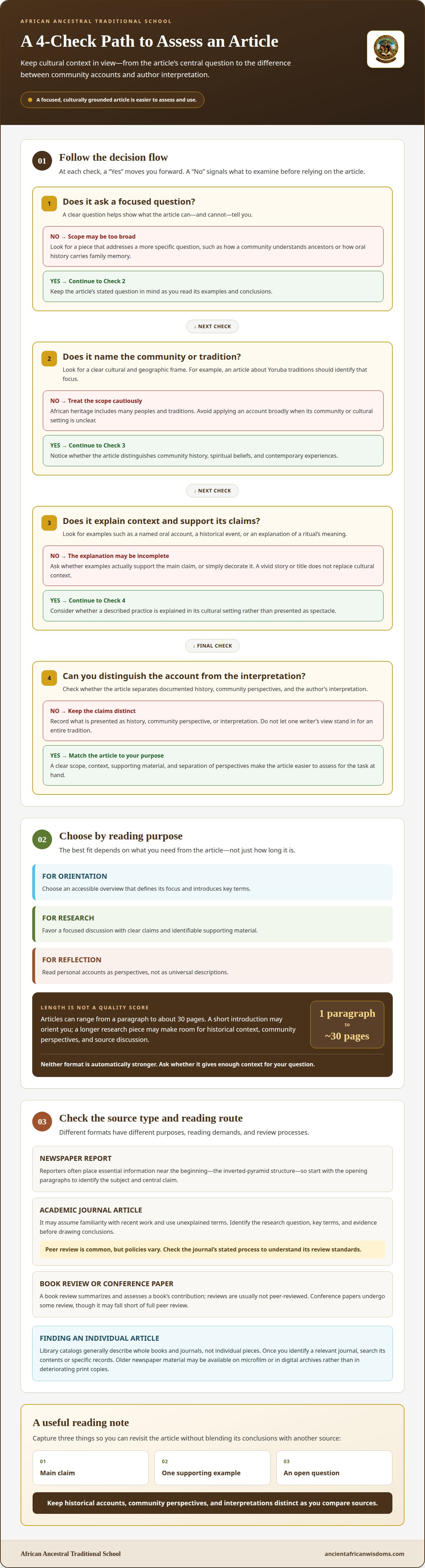
Use a simple sequence to assess an article. First, identify its main question. Next, note the community or tradition it names. Then look for supporting examples, such as an oral account or an explanation of a ritual’s meaning. Finally, distinguish the writer’s interpretation from the community’s own account. This approach keeps important context in view.
A vivid title or story may draw you in, but context gives an account its value. If an article describes a ritual, consider whether it explains the cultural setting and significance rather than presenting the practice as spectacle. If it discusses ancestral memory, notice whether it connects personal experience with history. These distinctions help you choose thoughtful reading for reference or further study.
Articles read
Read with a question in mind, such as how a tradition understands ancestors or preserves family memory. Start with the title and opening paragraphs to identify the subject and central claim. Newspaper reporters often place essential information near the beginning. This inverted-pyramid structure helps you grasp the main point before considering the supporting details.
Academic journal articles call for a different pace. They may assume readers know recent work in their field, so unfamiliar terms can appear without basic explanations. Pause to identify the research question, key terms, and evidence before drawing conclusions. A scholarly journal is often peer-reviewed, but publishing policies vary. Check the journal’s stated process to understand its review standards.
Distinguish research articles from book reviews. A review may summarize a book’s argument and assess its contribution, but reviews, including those in scholarly journals, are usually not peer-reviewed. Conference papers also undergo some review, though the process may fall short of full peer review. These formats have different purposes: a review introduces a book’s ideas, while a conference paper presents research.
Finding a specific article may take more than searching a library catalog. Catalogs generally describe whole books and journals, not individual pieces within them. Once you identify a relevant journal, search its contents or specific records. Older newspaper material may be available on microfilm or in digital archives rather than in deteriorating print copies. The format affects how you access and read a source.
Articles become easier to assess when you record the author’s main claim, evidence, and open questions. For example, separate a historical account from an interpretation of ancestral practice. That distinction helps you compare sources without blending their conclusions. Articles can also prompt further questions for study. If reading inspires a deeper path, continue exploring African ancestral traditions through further learning.
Best articles
The right article depends on the question you want answered. For family history, look for writing focused on a specific migration, language, or memory practice. For spiritual study, seek a clear discussion of beliefs and their place in daily life. Matching the topic to your purpose makes reading more useful.
Next, examine how the writer builds the explanation. A useful article connects its main claim to examples, such as a named oral account, a historical event, or a described practice. Ask whether those examples support the conclusion or simply decorate it. If the title promises history but the text mainly offers personal reflection, account for that difference in your research.
Pay attention to whose perspective shapes the account. An article about Yoruba ancestral beliefs, for example, should make its cultural focus clear. It should also distinguish documented history, community perspectives, and the author’s interpretation. This clarity helps prevent one writer’s view from standing in for an entire tradition.
Notice how an article handles unfamiliar terms. A clear explanation introduces a concept in context and then uses it consistently. If “ancestor” means a family forebear in one passage and a spiritual presence in another, look for an explanation of the shift. Precise language makes it easier to compare ideas without flattening their meaning.
- For orientation: Choose an accessible overview that defines its focus and introduces key terms.
- For research: Favor a focused discussion with clear claims and identifiable supporting material.
- For reflection: Read personal accounts as perspectives, not as universal descriptions.
Keep a brief reading note with the author’s central claim and one supporting example. Add a question the article leaves open, such as how a practice changed across generations. This makes the piece easier to revisit and helps guide your next reading choice.
Articles are especially useful once you have narrowed your topic and need specific information. Compare each piece with the question you want to answer rather than collecting more general introductions. Keep your reading focused on the issue at hand. If an article answers only part of your question, note the gap and use it to guide what you read next.
Articles that
A useful reference article makes its purpose clear. A short piece may introduce one idea, such as how a family remembers ancestors. A longer study may explore historical context, community practice, and changing interpretations. Length alone does not show whether a source suits your question. Check what the article explains and what falls outside its scope.
For a quick introduction, a brief article or review can help define unfamiliar terms. Reviews are usually shorter than one page, making them useful for a concise account of a book’s argument. They do not replace the book itself. For example, a review of a work on oral tradition may point you toward themes for deeper research.
A focused research question often calls for a longer article. Articles can extend from a paragraph to about 30 pages, allowing room for evidence and context. A journal article on a specific community’s ancestral practices may explain its approach, discuss sources, and distinguish findings from interpretation. This detail matters when you need more than a general introduction.
Consider where the article appears, too. Articles are usually part of a larger work, such as a journal, newspaper, or anthology. A journal article may address readers familiar with its field, while a newspaper article often puts key information near the beginning. The format shapes both the article’s depth and the reading experience.
- For a starting point: Choose a concise overview with a clearly defined subject.
- For closer study: Select a longer piece that explains its sources and context.
- For a specific claim: Find the original article or book behind a review.
Let your research task guide the choice. If you’re tracing one practice across generations, a detailed study may offer useful context. If you’re first learning a term, a short overview may be enough. Continue your study of African ancestral traditions with a reading purpose in mind.
African Ancestral Traditional School
Ancient African Wisdoms offers a structured path from reading about heritage to sustained learning. Its online courses explore African spirituality, culture, and tradition through four learning levels. Level One, Roots, includes five foundation courses, each eight weeks long. Students can progress through the curriculum and connect with a learning community while studying ancestral teachings and practical rituals.
If articles have raised questions you want to explore more fully, or you’re ready to connect cultural knowledge with ongoing spiritual learning, consider a structured course. Begin with the subject that matters most to you and continue at a pace that feels grounded and purposeful.
Contact African Ancestral Traditional School to explore your learning journey.
Carry Your Curiosity Forward
Articles on African ancestral traditions can open a door, but your questions give the journey direction. Choose one idea that stayed with you and consider what you hope to understand more deeply. You might reflect on how heritage shapes identity or how ancestral wisdom can inform life today. Let that question guide your next step.
Learning can unfold through steady attention, reflection, and connection. You don’t need to resolve every question at once. Give each insight room to settle, and let your understanding grow with care and respect for the traditions you explore.
If you’re ready to continue, contact African Ancestral Traditional School to explore a meaningful next step in your learning. Approach the path with patience and an open heart. Your curiosity can become a lasting connection to heritage.


