

No single doctrine can contain African Culture & Philosophy. The term encompasses a wide range of intellectual traditions, questions, and methods shaped across African societies and carried into dialogue with African diaspora thinkers. Its history is not confined to one place or one way of reasoning.
You may already sense that philosophy is more than abstract ideas: it can shape how people understand community, identity, knowledge, and a meaningful life. This article explores how African philosophy is defined, how its thinkers and methods developed, and why diaspora philosophy belongs within that history rather than at its margins. Along the way, you’ll encounter enduring ideas such as ubuntu and see how different approaches bring inherited knowledge into conversation with modern life.
Key Takeaways
- Follow the development of African philosophical thought through scholars, writers, and changing intellectual movements.
- Compare communitarian, complementarity, and conversational approaches to see how each frames knowledge and relationships.
- Use the article’s criteria to distinguish African philosophy as a diverse field rather than a single doctrine.
- Explore how diaspora thinkers extend the field through distinct histories, questions, and intellectual exchanges.
African philosophers and intellectual history
African philosophical thought has never followed a single path. The scholarship of Ahmed Baba and the writing of Nana Asma’u show how varied voices have shaped its intellectual history.
Regional and Historical Differences
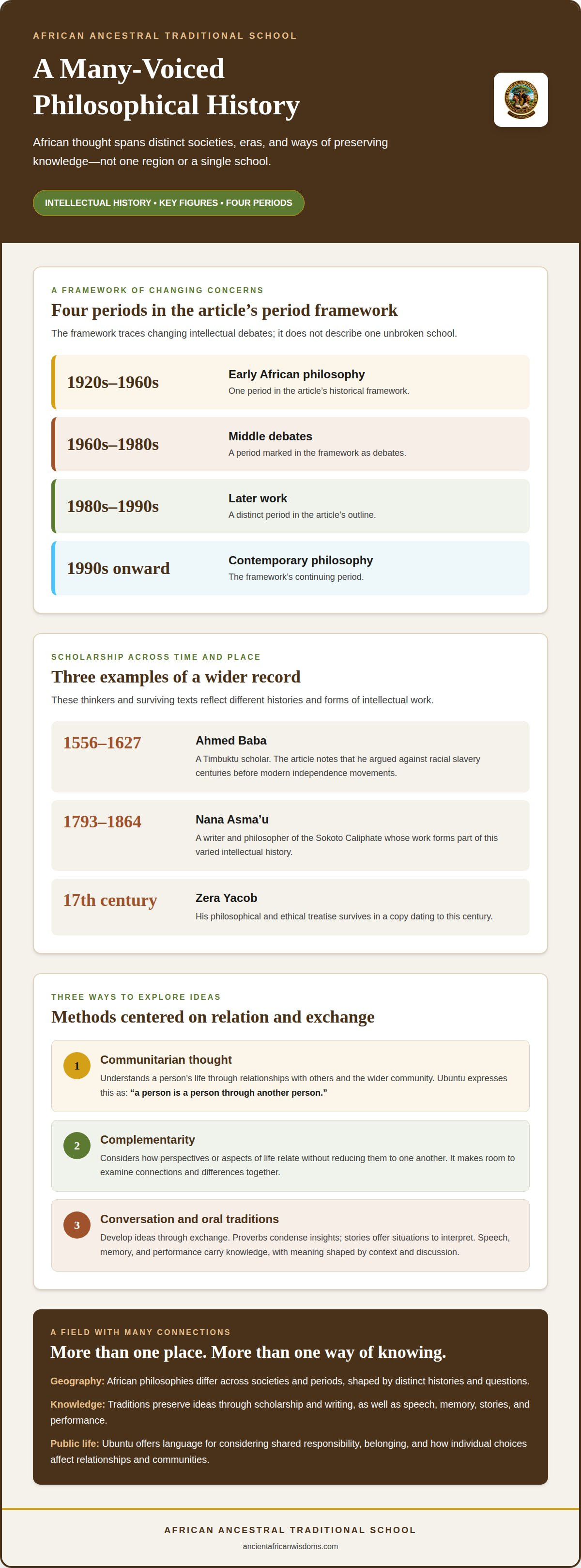
African philosophies differ across societies and periods, reflecting distinct histories, questions, and ways of preserving knowledge. Their intellectual record includes Ahmed Baba, a Timbuktu scholar who lived from 1556 to 1627, and Nana Asma’u, a writer and philosopher of the Sokoto Caliphate who lived from 1793 to 1864. Zera Yacob’s philosophical and ethical treatise survives in a copy dating to the 17th century. These examples matter because they challenge the idea that African philosophy belongs to one region or era.
Religion and Spiritual Beliefs
Religious and spiritual beliefs influence philosophy by shaping questions about ethical conduct, knowledge, community, and human purpose. Their expressions vary across African cultures, so no single account represents every tradition. Spiritual teachings and rituals, for example, can carry ideas about responsibility and belonging alongside practices of faith. Recognizing this connection helps readers see culture as more than abstract theory: beliefs can inform how people interpret obligations, relationships, and meaningful action.
Colonialism and Independence Movements
Colonialism and independence movements shaped African philosophy by intensifying debates about who defines knowledge, identity, and political freedom. Western scholars have discussed African philosophy and culture for over two centuries, while African thinkers have also developed arguments from their own intellectual traditions. The history is not a simple sequence: Ahmed Baba argued against racial slavery centuries before modern independence movements. A period framework places early African philosophy in the 1920s to the 1960s, middle debates in the 1960s to the 1980s, later work in the 1980s to the 1990s, and contemporary philosophy from the 1990s onward. This context helps readers distinguish changing intellectual concerns from one unbroken school.
Influence on Society and Politics
African philosophies influence contemporary society and politics by offering ways to consider shared responsibility, belonging, and public life. A common expression of ubuntu is that a person is a person through another person. This idea can frame discussions about how individual choices affect relationships and communities. It does not settle every political question, but it gives people a language for weighing personal interests alongside collective well-being. Understanding this influence helps readers recognize philosophical ideas in everyday debates about leadership, social ties, and civic responsibility.
Communitarian, complementarity, and conversational methods
Communitarian, complementarity, and conversational approaches are important ways of exploring African philosophy. Together, they consider relationships, connections between ideas, and shared interpretation.
Communitarian Thought
Communitarian thought understands a person’s life through relationships with other people and the wider community. A common expression of ubuntu is that a person is a person through another person. This idea offers a way to consider how choices affect individuals and those around them. It matters because it places belonging and responsibility within philosophical reflection, rather than treating each person as separate from society.
In practice, a communitarian reading asks how a decision shapes mutual obligations and shared well-being. Ubuntu offers a familiar example, but it does not make every African tradition identical. This approach gives readers a lens for considering how community can inform ideas about identity, conduct, and the good life.
Complementarity in Philosophy
Complementarity considers how different perspectives or aspects of life may relate without being reduced to one another. It matters because it allows a question to be examined through more than one lens. A discussion of personal responsibility, for example, can also consider communal ties without assuming one cancels out the other.
This method encourages careful attention to connections and distinctions. A reader might ask what each perspective reveals, where they meet, and where they remain different. Rather than forcing a single answer, complementarity can make room for a fuller account of a subject. Its value lies in the inquiry: it helps people consider related ideas together while examining their particular meanings.
Conversation and Oral Traditions
Conversational philosophy develops ideas through exchange, while oral traditions carry knowledge through speech, memory, and performance. Proverbs and stories make this approach tangible: a proverb can condense an insight, while a story gives listeners a situation to interpret. Both invite reflection rather than presenting every conclusion as a formal rule.
Meaning also depends on the setting and the people taking part. Listeners may discuss a proverb’s lesson, consider how a character acted, and connect the example to a present concern. This exchange makes interpretation part of learning. It also shows why oral forms deserve attention as intellectual practices, not merely as entertainment or decoration.
Readers who want to continue exploring these traditions can learn through digital courses on African culture.
Definitions and criteria for African philosophy
African philosophy is philosophical inquiry connected to African histories, societies, intellectual traditions, or thinkers. Scholars differ on which connection matters most. A geographic definition emphasizes work developed on the continent; a cultural definition considers ideas rooted in particular communities. These approaches matter because they prevent one narrow test from deciding whose thought belongs.
One useful distinction separates philosophy about Africa from philosophy produced through African intellectual traditions. A study can examine African societies while relying mainly on outside concepts. Another can draw on local languages, histories, or methods of reasoning to question knowledge and ethics. The subject alone doesn’t settle the definition; the source of its concepts and the way it argues matter, too.
Readers can assess a philosophical work by considering its questions, context, and reasoning. Does it examine knowledge, reality, ethics, or political life? Does it engage with specific African histories or traditions? Does it offer reasons readers can examine, rather than presenting a community’s beliefs as automatically shared by everyone? These criteria support careful reading without treating diverse African cultures as one uniform worldview.
Method also complicates the definition. A proverb, oral account, or written argument may each carry philosophical reflection, but their forms differ. A proverb can express an ethical claim compactly; analysis can then ask what assumptions it makes and whether those assumptions hold in a particular situation. Considering form and argument together helps readers recognize thought without assuming every cultural expression is philosophy in itself.
The history of the word “philosophy” raises another question. In the 21st century, Egyptologists have explored whether Greek “philosophos” may derive from the Egyptian concept “mer-rekh,” meaning “lover of wisdom” or knowledge. This proposed connection invites inquiry into African intellectual histories and the terms used to describe them. It doesn’t, by itself, establish one universal definition.
In practice, consider several criteria together: intellectual context, the questions being asked, and the reasoning offered. For example, a discussion of justice grounded in a specific African history can be assessed through its argument, not merely its location. This layered approach makes room for difference while keeping philosophical claims open to thoughtful examination.
African diaspora philosophy
African diaspora philosophy develops through intellectual work shaped by African heritage and life beyond the continent. It belongs within African philosophy’s history, while addressing experiences formed through migration, displacement, and new cultural settings. Consider a thinker examining identity across generations: the inquiry can draw on African intellectual traditions while responding to the society where that thinker lives. Diaspora thought is therefore connected to African histories, not simply a copy of ideas from the continent.
Questions of belonging, memory, freedom, identity, and the meaning of home often arise in diaspora philosophy. These themes become philosophical when thinkers examine their assumptions and consequences. A discussion of cultural identity, for example, can ask how inherited practices change across generations and who gets to define authentic belonging. This approach recognizes that diaspora communities are diverse. Shared ancestry doesn’t erase differences in language, religion, local history, or personal experience.
Historical context matters. Forced movement and colonial power shaped the conditions in which African-descended communities formed and preserved knowledge. A diaspora thinker might examine how those histories influence present ideas about justice or self-determination. The point isn’t to collapse distinct experiences into one account. Rather, historical awareness helps explain why similar questions can receive different answers in different places and communities.
Dialogue across locations also enriches this intellectual history. A concept may travel, gain new meaning, and return to conversation with other African traditions. For instance, a community’s account of responsibility can be compared with another society’s ethical reasoning without treating either as a universal template. Readers can trace the context, attend to differences, and consider the argument itself. This practice makes diaspora philosophy a living exchange, not a detached branch.
The central takeaway is to read diaspora philosophy through both connection and difference: follow its African intellectual roots, then attend to the local histories shaping each argument. To explore these connections through guided study, explore courses on African spirituality, culture, and tradition.
African Ancestral Traditional School
African Ancestral Traditional School offers a learning path for readers who want to explore African heritage beyond philosophical concepts. Its digital courses and African Ancestral Traditional School Levels bring together cultural learning and Ancestral Spiritual Teachings, while Community Access supports shared exploration. Spiritual Rituals are also part of its offerings.
Turn to this learning path when you want to deepen your understanding of African spirituality, culture, and tradition alongside the ideas explored here. Structured digital study and community access offer a way to continue engaging with ancestral knowledge. The courses are educational and do not promise spiritual results.
Contact African Ancestral Traditional School to take the next step in your learning.
Carry These Ideas Into Your Own Learning
Let African Culture & Philosophy become a continuing inquiry, not a set of ideas you leave on the page. Choose a question that stays with you, then consider how its meaning changes across generations, communities, and your own experience. That thoughtful practice can make learning a living connection to heritage rather than a search for one final definition.
As you continue, give yourself room to listen, reflect, and deepen your understanding at a steady pace. African Ancestral Traditional School offers a place to pursue that study through structured learning and shared exploration. If you’re ready to take a next step, contact African Ancestral Traditional School and begin a conversation about your learning journey.
Your path doesn’t need to look like anyone else’s. Let curiosity guide you, and carry what you learn into the relationships and choices that shape your life.
Frequently Asked Questions
What is African philosophy and what are its main themes?
African philosophy examines questions of knowledge, ethics, reality, and human life through African intellectual settings and arguments. African Culture & Philosophy cannot be reduced to one doctrine; a useful way to approach a specific text is to identify its question, context, and reasoning. For example, consider an ethical claim by asking who bears responsibility and how the argument supports that responsibility.
What are the core values and principles found in African cultures?
No single list describes every African culture. Recurring concerns in the traditions discussed include community, responsibility, wisdom, and ethical conduct, but their meaning depends on cultural and historical context. Treat these as themes to investigate, not traits shared uniformly. For example, a community’s account of responsibility may raise questions about how personal choices affect others without prescribing one answer for every society.
What are influential African philosophers and their key ideas?
Ahmed Baba, a scholar of Timbuktu, argued against racial slavery. Nana Asma’u was a leading woman philosopher and writer of the Sokoto Caliphate. Zera Yacob is identified as an Ethiopian philosopher associated with a philosophical and ethical treatise. These examples show different forms of intellectual work. When discussing a thinker’s ideas, distinguish documented positions from broader interpretations of their historical importance.
What are the debates over Ubuntu, communitarianism, and individualism?
Debates often consider how communal responsibility can coexist with personal autonomy. Ubuntu can frame people as connected, while individualism emphasizes a person’s agency and choices. These ideas needn’t be treated as opposites: a person may make an independent decision while considering its effects on others. To examine a specific debate, ask whether a communal expectation allows disagreement and whether an appeal to autonomy recognizes shared responsibilities.


