
African Traditional Practices are not only sacred customs; they can shape how people understand family, community, nature, and daily life. In Indigenous African religions, spirits may be understood as intermediaries between God and humans, while Orisa are associated with divine powers in Yoruba traditions. These beliefs live through practices and relationships, not only through formal rituals.
Approach African Traditional Practices with curiosity and care. These traditions are diverse, rooted in particular communities, and meaningful to people today. This guide explores how spiritual beings connect people with divine power, how belief can inform everyday life, and how African religious traditions traveled beyond the continent. It offers an introduction to the ideas behind these practices while recognizing that Africa’s many traditions do not form a single path.
Key Takeaways
- Understand how spirits may connect people with divine power and influence relationships with the sacred.
- Explore how migration, trade, and travel carried African religious traditions into communities beyond the continent.
- Learn how Yoruba accounts describe Orisa as carrying delegated powers and serving distinct roles.
- See how spiritual beliefs can shape identity and everyday life, and how structured teachings can support deeper study.
Spirits as intermediaries between God and humans
In Indigenous African religions, the spiritual realm is central to how people understand life and divine power. Spirits may serve as intermediaries between God and humans, connecting sacred beliefs with human experience.
Mythological Figures and Nature Spirits
Spirits and mythological figures help explain relationships among divine power, people, and the natural world. Nature spirits are associated with aspects of nature, while some traditions also recognize harmful or “bad” spirits. These beliefs shape how communities interpret events and approach the unseen. Yoruba accounts, for example, include Orisa, spiritual beings connected with divine power.
Spirit Possession
Spirit possession describes the belief that a spirit can enter or influence a person. Its meaning depends on the tradition and setting; it may be understood as a spiritual encounter, not simply an individual experience. The community’s beliefs and interpretation help explain what the experience signifies. In some traditions, possession is understood within a sacred relationship between people and spirits.
Healing may involve herbal knowledge, spiritual belief, or both. Herbal healing uses plants, while spiritual healing addresses relationships with spirits, ancestors, or divine power. These are distinct dimensions of care, not interchangeable approaches. A tradition may attach meaning to a plant, a ritual, or both, according to its teachings. Recognizing this distinction helps readers approach healing customs respectfully without assuming every community follows the same practice.
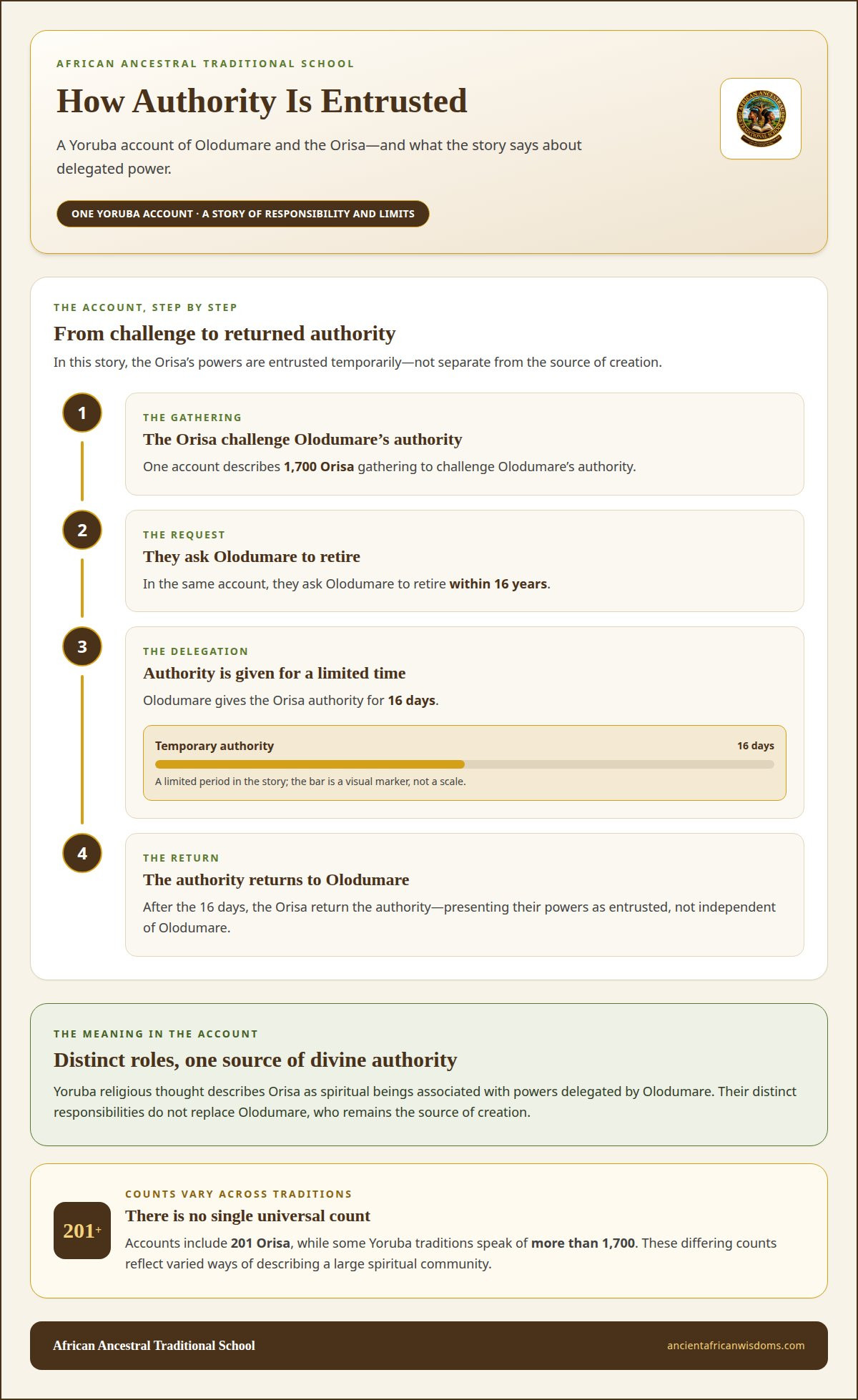
The intermediary role of spirits appears clearly in Yoruba stories about Olodumare and the Orisa. One account describes 1,700 Orisa gathering to challenge Olodumare’s authority. The same story says they asked Olodumare to retire within 16 years, then received authority for 16 days before returning it. Yoruba traditions give different counts, including 201 Orisa and more than 1,700. These accounts illustrate how spiritual beings may be understood as carrying powers connected to divine authority.
The spread of African religious traditions beyond Africa
Trade, travel, the Atlantic slave trade, and later migration carried African religious traditions to Europe and North America. The forms these traditions took reflect the histories and communities that carried them.
Practices vary by region, ethnic group, and country because communities preserve and interpret traditions through their own histories. Legal protections also differ by country, whose laws may treat religious practice, sacred places, and cultural heritage in different ways.
Yoruba Traditional Religion
Yoruba traditional religion is a diverse spiritual tradition rooted in West Africa, especially among Yoruba communities. More than 20 million Yoruba people live in West Africa, primarily in southwest Nigeria and also in Ghana, Togo, and elsewhere in the region. Its presence across national borders helps explain why a tradition cannot be reduced to one country. For readers, this context makes room to understand shared heritage alongside local expression.
Regional and Cultural Variation
Regional and cultural variation gives beliefs and customs distinct forms across communities and countries. A practice that is meaningful in one community may play a different role elsewhere, shaped by local history, language, and spiritual understanding. When learning about African traditions, do not treat one example as universal. Consider its cultural setting and the people who maintain it before drawing conclusions about another group.
In Indigenous African religions, the supernatural realm is central to understanding existence. God is believed to sustain creation, rule the universe, and hold all power. Religious leaders, priests, rain-makers, and healers may have distinct responsibilities within their communities. A healer, for example, may connect spiritual understanding with community care, while a rain-maker’s role relates to rainfall. These roles and their meanings vary across traditions.
As traditions traveled, they encountered new communities and religious settings. Syncretism describes the blending or interaction of religious beliefs and practices. It helps explain how traditions adapted in diaspora communities while retaining African roots. The Atlantic slave trade forcibly displaced people; later migration and ongoing travel also carried customs and beliefs abroad. These different histories shaped how communities preserved, transformed, and passed on spiritual practices.
Explore African cultural and spiritual teachings to continue learning with care.
Orisa and delegated divine powers
In Yoruba religious thought, Orisa are spiritual beings associated with powers delegated by Olodumare. This relationship shows how divine authority can remain supreme while sacred responsibilities are carried through distinct spiritual figures. The idea is not simply that many beings exist; it describes an ordered connection between divine power and the world people experience.
A Yoruba account illustrates that relationship through a dispute between Olodumare and the Orisa. In the story, the Orisa sought authority, and Olodumare allowed them to take charge for 16 days before returning to him. The temporary delegation presents their powers as entrusted, not separate from the source of creation. It also gives the story a lesson about authority, responsibility, and limits.
Traditions differ in how many Orisa they recognize. Accounts include 201 Orisa, while some Yoruba traditions speak of more than 1,700. These differing counts reflect varied ways of describing a large spiritual community, rather than a single universal list. Five Orisa are particularly revered in Yoruba traditions and have shrines throughout the country. Their prominence shows how spiritual roles can be honored through community practice.
Delegated power helps explain why Orisa may be associated with distinct aspects of life without replacing Olodumare. Yoruba accounts describe relationships and accountability: the Orisa act within an order, with authority ultimately returning to its source. This framework also distinguishes reverence for an Orisa from belief in a separate creator.
Read each account within its own tradition. These figures and their roles belong to Yoruba religious understandings; they do not represent every African spiritual system. Reading accounts of Olodumare alongside traditions that recognize different Orisa can reveal how communities express divine authority, responsibility, and sacred connection through their inherited teachings.
ATR's cultural identity and daily practices
Across African communities, spiritual beliefs can shape identity, relationships, and everyday choices. Practices differ, so a custom from one community should not be treated as a rule for the whole continent.
Types of Traditional Practices
Traditional practices include spiritual observances, healing customs, and rites connected with community life. Their variety matters because it shows why no single example can represent every African tradition. In 14 of the 19 surveyed African countries, more than 30% of people sometimes consult traditional healers when someone in their household is sick. This example points to healing as one part of a broader cultural landscape, not a universal practice.
Beliefs also differ across countries. In 11 surveyed countries, roughly a quarter or more of the population believes in the protective power of juju, shrines, and other sacred objects. In Senegal, 75% hold this belief. These figures show variation, rather than one shared pattern. Beliefs in the evil eye and reincarnation also appear across surveyed countries, with local differences in how people understand them.
Practices Around Life Events
Birth, marriage, and death customs mark major transitions and affirm relationships. These events can connect personal change with family, ancestors, and community identity. Their form varies by tradition; no single ceremony or sequence describes every African community.
For visitors, respectful learning starts with context: identify the community and tradition, listen before interpreting, and follow local guidance about participation or photography. A shrine, family gathering, or public celebration can hold different meanings in different settings. Do not treat one observation as representative of an entire country.
Everyday beliefs may include ideas about protection and spiritual influence. In every surveyed African country, more than one in five people believes in the evil eye. In most surveyed countries, at least three in ten people believe in reincarnation. These beliefs may influence how people interpret life events, but they do not define everyone’s choices or identity.
Use these examples as a starting point, not a complete account. Explore African cultural teachings to deepen your understanding of the traditions and contexts behind daily practices.
African Ancestral Traditional School: African Ancestral Traditional School Levels
African Ancestral Traditional School offers structured learning for readers who want to deepen their understanding of African spirituality, culture, and tradition. Its African Ancestral Traditional School Levels provide a progressive path through ancestral teachings, and Community Access connects students with others exploring this heritage.
Turn to these teachings when an introduction raises further questions about spiritual beliefs, cultural meaning, or traditional practices. Ancestral Spiritual Teachings and Spiritual Rituals are among the school’s offerings, alongside structured courses and community learning. These opportunities support ongoing exploration without reducing diverse traditions to a single explanation.
If you’d like to continue your learning, contact African Ancestral Traditional School.
Carry Your Learning Forward
Take a patient, grounded approach as you explore African Traditional Practices. Pay attention to the specific communities, histories, and teachings behind each tradition. Reflection can connect what you learn with your own questions, while continued study deepens understanding over time.
African Ancestral Traditional School offers structured learning levels, ancestral spiritual teachings, and community access for continued learning and connection. These offerings can help you move beyond an introduction and develop a more considered relationship with ancestral wisdom.
If you’re ready to continue that journey, contact African Ancestral Traditional School. Take the next step at a pace that feels thoughtful, and let each new lesson open space for deeper understanding.
Frequently Asked Questions
What are African traditional practices?
African traditional practices are diverse customs and ways of understanding life, community, and spirituality, rooted in particular cultural traditions. They may include ceremonies, healing knowledge, oral teachings, and customs that mark important life events. Details depend on the community and its history, so the phrase describes many traditions, not one uniform system. Learning the local context helps prevent treating a single custom as universal.
What role do traditional practices play in African spiritual and religious life?
Traditional practices can bring spiritual beliefs into daily relationships, community responsibilities, and personal milestones. For example, a family custom may express respect for ancestors or connect a life event with shared beliefs. The role of these practices varies among communities and individuals. Some people observe particular customs as part of family heritage, while others understand them through a broader religious identity.
How are African traditional healing practices used, and what are their risks?
African traditional healing practices may involve herbal knowledge, spiritual understanding, or both, depending on the community and the concern. Risks include using a misidentified plant, preparing it improperly, or combining remedies with medication. Spiritual practices should not replace medical assessment when someone is ill. Understanding what a practice involves and where its limits lie helps people approach healing thoughtfully.
How have African traditional practices changed over time?
African traditional practices have adapted as communities, families, and spiritual traditions encountered new circumstances. Migration can carry teachings into new settings, where people may preserve some customs and reinterpret others. Religious exchange can also lead to syncretism, the interaction or blending of beliefs. Change does not necessarily mean a tradition has disappeared; its meaning may continue through different forms of teaching and observance.
How do African traditional practices compare with Christianity and Islam in Africa?
African traditional religions, Christianity, and Islam have distinct teachings and forms of worship, but people’s lived religious identities can be more varied than simple categories suggest. In some settings, traditional customs interact with Christian or Muslim beliefs; in others, people keep practices more separate. Do not assume that a person’s religious affiliation tells you exactly which cultural customs they follow.
How do colonization and globalization affect African traditional practices?
Colonization and globalization can shape how traditions are practiced, taught, and understood. Migration, trade, and travel have carried African religious ideas across borders, while contact with other faiths can prompt adaptation or blending. Communities also decide which teachings to preserve and how to pass them on. To understand a specific change, consider its local history and the people who sustain the tradition.


