
In some African traditions, ancestors are regarded as protectors and guides, and neglecting them is believed to unsettle descendants’ lives. The spiritual consequences of ignoring your ancestors depend on the tradition and family beliefs involved. Ancestral guidance may bring comfort and connection, but it should not be presented as a guaranteed end to pain or suffering.
If you feel drawn to your lineage, or pressured to honor beliefs that do not feel right to you, that tension deserves care rather than judgment. Learn how ancestral guidance is understood, what different traditions teach about suffering, and how family expectations can shape your choice to embrace or reject these beliefs. African ancestral teachings can offer a grounded way to explore heritage while leaving room for your own reflection and agency.
Key Takeaways
- Understand that beliefs about ancestral blessings, spiritual disruption, and suffering vary across cultures; spiritual practices aren’t a guaranteed way to remove pain.
- Notice how family expectations shape your relationship with ancestral beliefs, and reflect on recurring patterns across generations.
- Explore how some African traditions understand ancestors as guides and protectors, while making space for your own thoughtful choices.
- For structured learning about African spirituality and heritage, consider the school’s teachings, levels, rituals, and community access.
Can the Ancestors Take Away My Pain and Suffering?
Can ancestors take away pain? Traditions offer different answers, and no shared belief can promise that physical suffering will end. In some families, ancestors may bless descendants, while neglect is believed to invite misfortune or a curse. These are spiritual interpretations, not proof that illness or hardship means someone has offended the dead. Remembering a grandparent may bring comfort without changing a medical condition.
Beliefs about neglect differ across cultures and religions. Some communities emphasize honoring ancestors, while others understand the dead through different spiritual frameworks. Hindu and Buddhist teachings also vary; there is no single shared rule that neglecting ancestors brings punishment. Consider the specific tradition and family context before treating one community’s teaching as universal.
Chinese ancestor veneration offers a clear example of remembrance as a family practice. During Qingming, families visit and clean ancestors’ graves, light incense, and leave offerings. These actions express respect and maintain a bond with those who have died. They may also give relatives a shared way to remember, but they do not establish that an ancestor can remove pain on demand.
Approach practices from another culture with care. Learn a ritual’s meaning from people rooted in that tradition, and do not copy sacred acts as decoration or entertainment. A practice that feels grounding to one person may feel intrusive or spiritually troubling to another. If a ceremony creates fear, pressure, or distress, pause and reflect instead of treating that reaction as evidence of a curse.
Psychological perspectives can consider how rituals shape memory, meaning, and connection. A quiet act, such as speaking a loved one’s name or tending a grave, may help someone express grief and feel connected to family history. That experience is personal, not a guarantee of healing. Notice whether the ritual brings reflection and connection or increases guilt and fear. The difference can guide what feels meaningful and safe for you.
Family and cultural pressure when rejecting ancestral beliefs
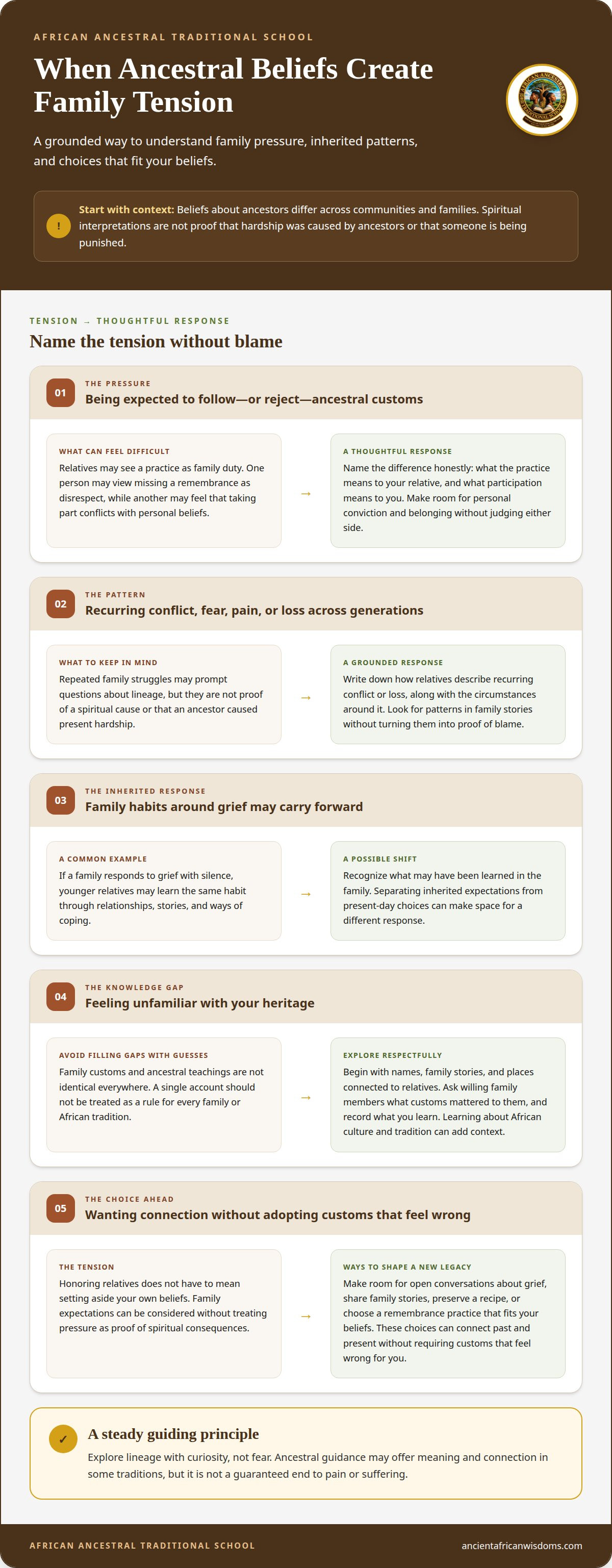
Rejecting ancestral beliefs can create tension when relatives see those practices as a family duty. The strain may surface during a memorial or a conversation about faith.
Pressure to Reject Ancestral Beliefs
Pressure can arise when family members expect you to follow ancestral customs or discourage you from honoring them. Either direction can leave you divided between personal conviction and belonging. For example, a relative may interpret your absence from a remembrance as disrespect, while you may see participation as conflicting with your beliefs. Naming that difference can make a difficult conversation more honest.
Recurring Family Struggles
Recurring struggles are fears, pain, or losses that appear across generations rather than isolated family events. Trace family stories and repeated experiences to notice patterns, without treating them as proof of a spiritual cause. For example, write down how relatives describe recurring conflict or loss and the circumstances surrounding it. This can reveal what your family has carried forward and where a different response may begin.
Inherited Patterns and Trauma
Inherited patterns can include responses learned through family relationships, stories, and ways of coping. They do not establish that trauma passes through a supernatural force or that ancestors caused present hardship. If a family responds to grief with silence, younger relatives may learn the same habit. Recognizing that pattern can help separate inherited expectations from choices you can make now.
If you’re unfamiliar with your heritage, begin with names, family stories, and places connected to relatives. Ask willing family members what customs mattered to them, and record what you learn without filling gaps with guesses. A course in African culture and tradition can also provide context for exploring heritage respectfully.
A new family legacy can start with one deliberate change, such as making room for open conversations about grief. You can honor relatives through shared stories, preserve a family recipe, or choose a remembrance practice that fits your beliefs. These acts connect the past with present values without requiring you to adopt customs that feel wrong for you.
African traditions and ancestral guidance
In some African traditions, ancestors are understood as protectors and guides within family life. Their connection can represent continuity between living relatives and those who came before. Beliefs differ across communities, so no single description covers every African tradition. The meaning of ancestral guidance depends on the teachings and practices a family has inherited.
In these traditions, the spiritual consequences of ignoring your ancestors may be understood as lost guidance, disrupted balance, or unresolved family pain. A difficult period might prompt reflection on relationships or neglected responsibilities, rather than an immediate conclusion that an ancestor is angry. This distinction matters: spiritual interpretation can invite reflection on lineage without turning every hardship into blame or fear.
One account describes a woman undertaking a three-week training course to become a prophet, hoping to appease her ancestors. The example shows how deeply ancestral beliefs can shape a person’s decisions. It does not establish that training changed her circumstances or that others should follow the same path. Family teachings and personal conviction influence how such experiences are understood.
Quiet reflection offers a different starting point. Set aside a calm moment to consider what you have learned about your family lineage and how those stories affect you today. Notice whether particular memories bring gratitude, grief, or unanswered questions. Reflection cannot establish what ancestors want, but it can help you approach your heritage with attention rather than assumption.
For example, you might remember a relative’s persistence during hardship and consider how that quality appears in your own life. You could also write down a family story and reflect on what it teaches about care, responsibility, or belonging. These steps connect ancestral guidance to lived memory instead of treating it as a guaranteed prediction.
Ideas about the spiritual consequences of ignoring your ancestors also vary according to a tradition’s teachings and family context. As you explore, learn the meaning of unfamiliar practices from people rooted in that tradition. Respectful learning leaves room for personal belief and discernment while helping you approach your heritage with care.
What are the spiritual consequences of ignoring ancestors in African traditional religions?
In some African traditions, ancestors are regarded as protectors and guides, and neglected spirits or unresolved ancestral pain are believed to disrupt descendants’ lives. The spiritual consequences may be understood as lost guidance, strained family relationships, or misfortune. These beliefs vary by community, so one interpretation cannot speak for every African tradition.
Within this worldview, a conflict at home or a recurring difficulty might prompt someone to consider whether family responsibilities or remembrance practices have been neglected. The event itself does not identify a spiritual cause. Its meaning comes from the person’s tradition, family teachings, and understanding of their lineage. That distinction helps prevent hardship from becoming an automatic accusation against a descendant.
For example, a person may feel disconnected from relatives, family stories, or inherited customs. They might interpret that distance spiritually, while another family member may focus on unresolved disagreements or lost communication. Both perspectives can shape how the family responds. Listening to elders and learning the meaning of a custom can clarify its place without treating every challenge as punishment.
Some interpretations connect ancestral neglect with disrupted balance or protection. That belief can encourage descendants to remember family teachings and repair relationships. It can also create fear if every illness, setback, or disagreement is blamed on ancestors. Consider the specific teaching before drawing conclusions, and distinguish a spiritual interpretation from a proven explanation for what happened.
A thoughtful response can begin with learning: ask what remembrance means in your family, notice which obligations elders describe, and reflect on your own beliefs. If a practice feels meaningful, approach it with respect for its cultural context. If pressure or fear is driving your choice, pause and seek understanding before acting. Responsibility and remembrance need not mean accepting blame for every hardship.
To study these teachings in a structured way, explore African ancestral spiritual teachings and deepen your understanding of the traditions behind ancestral guidance.
African Ancestral Traditional School: African Ancestral Traditional School Levels
African Ancestral Traditional School offers structured levels for exploring African ancestral traditions and spirituality. Turn to this learning path when you want more context than a brief overview can provide, or when you are ready to study teachings and practices with greater care.
The school’s Ancestral Spiritual Teachings and African Ancestral Traditional School Levels support deeper learning, while Community Access provides space to connect with others exploring heritage. Spiritual Rituals are also part of its offerings. Together, these resources can help you approach ancestral traditions as subjects for learning and reflection, rather than acting from fear or assumptions about hardship.
If you’d like to continue exploring African spirituality and ancestral teachings, visit ancientafricanwisdoms.com.
Carry Your Reflection Into a Deeper Path
Let reflection guide your next step, rather than fear of the spiritual consequences of ignoring your ancestors. Begin by writing down what you hope to understand about your lineage, the beliefs you want to explore, and the boundaries that matter to you. This gives your questions a clear place to begin.
Learning can also help you distinguish inherited teachings from assumptions formed under family pressure. African Ancestral Traditional School offers structured learning through its levels, Ancestral Spiritual Teachings, and Community Access. These resources may suit you if you are ready to explore African heritage with more context and connection.
Choose a pace that leaves room for honest reflection. You do not need to settle every question at once or follow a practice that does not align with your convictions. Let curiosity, respect, and thoughtful learning shape the way forward.
Explore your next step with African Ancestral Traditional School, and continue your journey with care and confidence.
Frequently Asked Questions
What do different cultures believe happens when people neglect ancestral traditions?
Beliefs differ: some communities understand neglect as weakening a spiritual relationship, while others do not treat ancestral observance as a religious obligation. Meaning also depends on family teachings and religious practice. For example, relatives may disagree about whether attending a remembrance gathering expresses devotion, respect, or simply family connection. Ask what a practice means within its own community before applying another culture’s interpretation.
What do Indigenous traditions teach about honoring or neglecting ancestors?
Indigenous traditions are diverse, so there is no single teaching shared by all Indigenous peoples. Beliefs about ancestors, kinship, land, and remembrance belong to distinct communities and histories. If you are learning about a particular people, begin with that community’s own accounts and terminology. Avoid treating one nation’s practice as a universal Indigenous custom, and respect boundaries around knowledge that community members consider private or sacred.
What rituals or practices are used to honor ancestors respectfully?
Respectful remembrance can be personal or communal, depending on family beliefs. You might speak a relative’s name, preserve a family story, prepare a remembered recipe, or gather with relatives to share memories. These acts do not need to imitate another culture’s ceremony. If you are considering a specific ritual, learn its meaning from people connected to that tradition and follow the guidance and boundaries they share.


