
A hopeful reply isn’t the same as acceptance: the seller must agree to your offer as written, rather than make a counteroffer or add conditions. The clearest signs your offerings have been accepted are an unqualified agreement and, in practice, a written contract signed by everyone involved.
It’s natural to look for certainty in a seller’s response, especially when you’re ready to move forward. A message showing interest or asking for clarification may signal serious consideration, but it doesn’t, by itself, mean the offer has been accepted.
This guide explains how to read seller responses, distinguish acceptance from a counteroffer or rejection, and understand what makes an offer accepted. You’ll also learn why the acceptance deadline and a signed agreement matter, so you can tell the difference between promising communication and a settled agreement.
Key Takeaways
- Interpret signs within the specific tradition and ritual, rather than assuming one meaning applies across cultures.
- Look to the ritual’s established guidance and context; a single physical change is not proof of acceptance.
- Treat dreams and personal experiences as reflections to consider, not automatic confirmation.
- If no clear sign appears, pause, reflect on the practice, and seek grounded guidance before repeating or changing the offering.
How do different religions and cultures interpret signs that offerings are accepted?
There is no single sign shared across religions. In Hindu puja, devotees may receive prasada, food offered during worship and then shared as blessed. Receiving it marks participation in the rite, but it isn’t a universal test of divine favor. Its meaning depends on the ceremony’s purpose, the deity honored, and the guidance followed by that community.
Christian traditions often frame acceptance through intention, faith, and ethical conduct rather than a visible change to an offering. The biblical story of Cain and Abel, for example, presents offerings alongside the worshippers’ dispositions. An answered prayer or a sense of peace may be meaningful to an individual, but neither universally proves that a particular offering was accepted.
In Buddhist practice, offerings such as flowers, water, or incense can express generosity and reflection on impermanence. A flower placed before a Buddha image may remind practitioners that life changes; its appearance afterward does not establish spiritual approval. The practice’s purpose and the practitioner’s intention matter more than treating a physical event as a guaranteed message.
Shinto practice in Japan includes offerings at shrines and household altars, where rice, salt, or water may be presented according to local custom. Completing the prescribed rite can be the meaningful marker, rather than receiving a separate sign. Customs differ among shrines and households, so one community’s interpretation shouldn’t automatically be applied elsewhere.
African traditional religions also encompass distinct peoples, lineages, and teachings, not one shared system of signs. In a Yoruba context, for instance, Ifá divination may provide guidance within its own established framework; it shouldn’t be treated as a shortcut for interpreting every offering. To understand a sign, identify the tradition, the rite’s purpose, and who is recognized to interpret it. Compare teachings within that lineage, not across unrelated practices.
How can you tell whether an offering was accepted in traditional rituals?
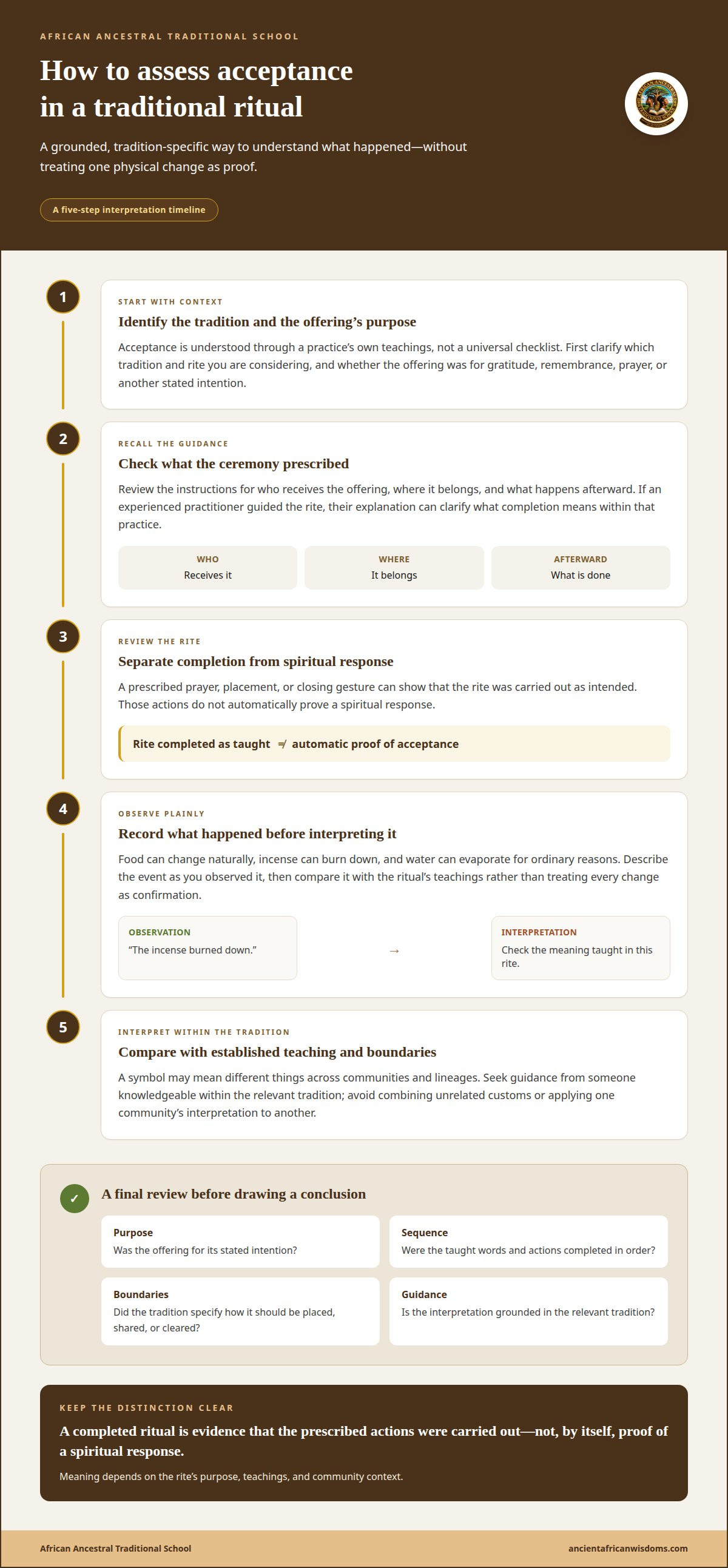
In a traditional ritual, acceptance is understood through that practice’s own teachings, not a universal checklist. A completed offering may follow a prescribed prayer, placement, or closing gesture. Those actions show that the rite was carried out as intended; they don’t automatically prove a spiritual response. Start by identifying the specific tradition and the offering’s purpose.
Next, recall the instructions for the ceremony. The guidance, for example, may explain who receives the offering, where it belongs, and what happens afterward. These details provide a firmer basis for interpretation than guessing from a candle’s flame or an object’s appearance. If an experienced practitioner guided the rite, their explanation can clarify what completion means within that practice.
Separate observable events from interpretations. Food can change naturally, incense can burn down, and water can evaporate for ordinary reasons. A ritual may assign meaning to an event, but that meaning depends on its teachings and setting. Record what happened plainly, then compare it with the instructions instead of treating every change as confirmation.
- Review the purpose: Was the offering for gratitude, remembrance, prayer, or another stated intention?
- Recall the sequence: Were the words and actions completed in the order taught?
- Respect the boundaries: Did the tradition specify how the offering should be placed, shared, or cleared?
- Seek interpretation carefully: Ask a knowledgeable guide within that tradition, rather than combining unrelated customs.
For African traditional practices, teachings differ across communities and lineages. A symbol meaningful in one context may not carry the same meaning in another. Learning the cultural foundations can help you understand ritual purpose without turning one experience into a rule for everyone. Courses on African spirituality, culture, and tradition can support that broader study.
Are dreams or other experiences interpreted as confirmation that an offering was accepted?
Dreams can feel significant after a prayer or offering, especially when they include a familiar ancestor, sacred place, or ritual object. Their meaning depends on the teachings and context through which they’re understood. A vivid dream is an experience, not automatic proof that an offering was accepted. The same image can carry different meanings across families, communities, and spiritual traditions.
Consider the sequence of events around the experience. Note the offering’s purpose, the dream’s main images, and any feelings that remained after waking. For example, a dream of a family home after an offering for remembrance may invite reflection on kinship. It doesn’t establish a universal message. Keep the description separate from your interpretation, so later reflection doesn’t turn a detail into certainty.
- Record the experience: Write down the dream or event soon after it happens, including specific images and words.
- Connect it to context: Recall the offering’s intention and the ritual instructions you followed.
- Look for established teaching: Compare your interpretation with the guidance of your own tradition.
- Hold the conclusion gently: Don’t change a practice or repeat an offering solely because of one dream.
Other experiences, such as a sense of calm, a meaningful coincidence, or an unexpected memory, can also feel connected. In a Christian setting, someone might reflect on a Bible passage that comes to mind after prayer. In an African traditional context, interpretation belongs within the relevant community and lineage. Neither example creates a rule that applies across traditions.
When an experience unsettles you, pause before treating it as an instruction. Review what happened, distinguish observation from belief, and seek guidance from someone grounded in the same tradition. A single dream about water, an ancestor, or a shrine cannot speak for every practice. Careful reflection honors the experience while respecting the teachings that give it meaning.
What should you do if there are no signs that an offering was accepted
If no clear sign follows an offering, don’t treat silence as rejection. Yoruba, Christian, and Buddhist traditions interpret practices through distinct teachings, not one shared test. Return to the rite’s stated purpose, such as gratitude, remembrance, or prayer. That purpose helps separate the offering itself from expectations of an immediate response.
Next, reconstruct what happened in sequence. Note the words spoken, materials presented, placement, and closing action. For example, if a household rite calls for water at an altar, record whether you placed it as taught. A missed step is a practical detail to clarify, not proof of spiritual displeasure. Avoid changing several parts at once, since that makes it harder to assess what happened.
- Pause before repeating: Give yourself time to consider the purpose and instructions of the specific rite.
- Review the sequence: Compare each action with the guidance you received, including how the offering was prepared and concluded.
- Keep a clear record: Write down what you did and observed, separating physical details from your interpretation.
- Seek tradition-specific guidance: Bring your questions to a knowledgeable person within the same community or lineage.
If you find an uncertainty, address that point carefully rather than adding unrelated customs. A Yoruba practice, for instance, shouldn’t be adjusted using a rule from another tradition without proper guidance. Ask what the rite teaches about completion, timing, and respectful handling of the offering. Those details provide a grounded next step without turning an absent sign into a verdict.
For a deeper understanding of African spiritual traditions and their cultural foundations, explore teachings on African spirituality and culture.
If the question instead concerns a home purchase, practical steps differ. In a multiple-offer situation with few competing offers, a buyer’s offer may have a better chance of acceptance. A lender reviews a preapproved buyer’s credit report to check that nothing has materially changed since the initial application. Mortgage pre-approval can show sellers that a buyer is serious and financially capable of closing the deal. Title insurance helps ensure no one else can claim the property and that the buyer isn’t liable for liens on it.
African Ancestral Traditional School
African Ancestral Traditional School offers a structured way to learn about ancestral practices and offerings in context. Its school levels and ancestral spiritual teachings cover African spirituality, culture, and tradition. This learning can help you understand how rituals fit within their cultural roots, rather than interpreting experiences through assumptions drawn from unrelated traditions.
Spiritual Rituals and Community Access also connect learning with practice and shared exploration. Turn to these teachings when you’re ready to deepen your understanding, reflect on questions about ritual meaning, or continue learning within a community setting. The school does not replace the distinct guidance of every lineage; it offers a place to build knowledge and engage with African ancestral traditions thoughtfully.
For a considered next step in your learning, contact African Ancestral Traditional School.
Carry Your Practice Forward With Care
Let learning guide your next step, rather than feeling pressured to find certainty in every experience. The signs your offerings have been accepted may hold personal meaning, but interpretation belongs within the teachings and community that shape your practice. Give yourself room to deepen that understanding over time.
If you’re ready to explore African ancestral traditions in greater context, continue learning through African Ancestral Traditional School. Its courses support thoughtful engagement with cultural heritage as you consider your own path.
Contact African Ancestral Traditional School to take that next step. Keep approaching your practice with patience, respect, and an open heart.
Frequently Asked Questions
What are common signs that a spiritual offering has been accepted?
Common signs your offerings have been accepted depend on the spiritual tradition; no single indicator applies everywhere. Some communities look to a prescribed divination practice or an elder’s interpretation, while others expect no distinct response. A personal feeling or coincidence may matter to you, but it isn’t universal confirmation. Learn which signs your own tradition recognizes before drawing a conclusion.
Are changes in an offering, such as flowers wilting or food disappearing, considered signs of acceptance?
Flowers wilting or food disappearing doesn’t, by itself, establish spiritual acceptance or count as reliable signs your offerings have been accepted. Cut flowers lose moisture, while food may be moved by household members, pets, or insects. For example, fruit left in a warm place can change condition without any connection to a ritual. Follow the tradition’s instructions for handling offerings, and don’t assign spiritual meaning to ordinary physical changes alone.
What signs do people look for after making offerings to ancestors or deities?
People looking for signs your offerings have been accepted turn to the forms of interpretation their own tradition recognizes, which may include divination or guidance from a ritual elder. No single sign applies to every ancestor, deity, or community. For example, the appropriate way to understand an offering made for remembrance may differ from one connected with a request. Keep the interpretation within the relevant tradition rather than combining unrelated customs.


