
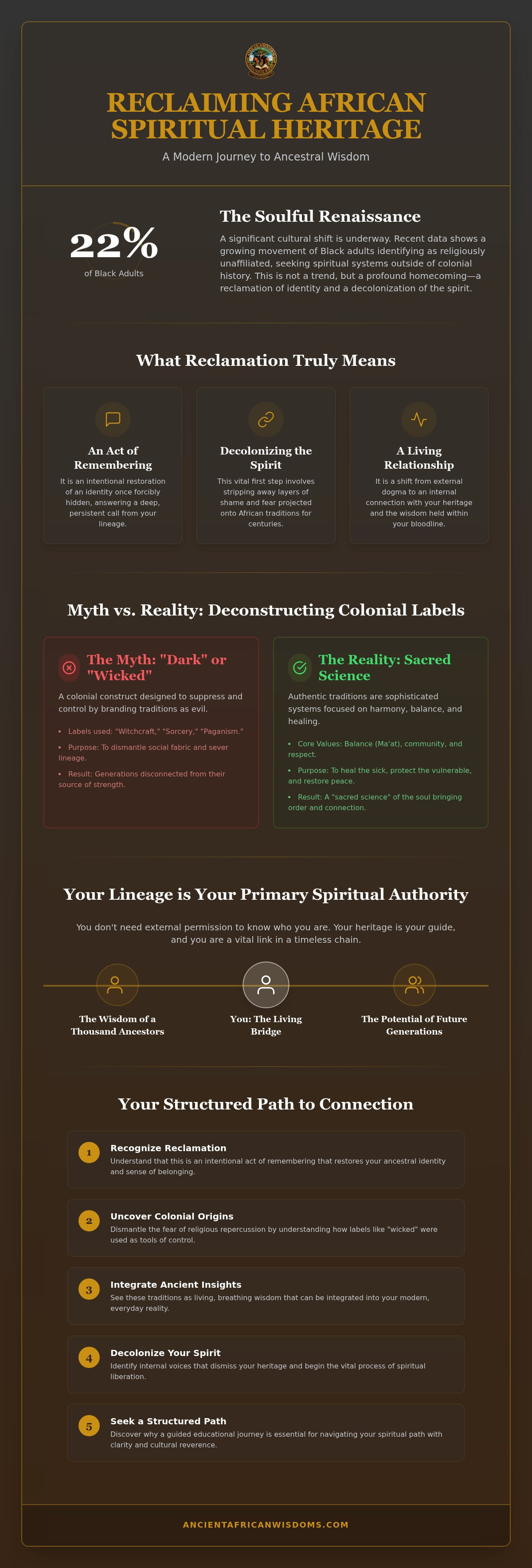
What if the traditions you were taught to fear are actually the keys to your deepest healing? Recent data shows that 22% of Black adults now describe themselves as religiously unaffiliated, reflecting a powerful movement toward ancestral roots. You're likely here because you feel a quiet pull toward your lineage, yet the weight of old labels like "witchcraft" or the fear of religious repercussion makes you hesitate. It's natural to feel disconnected when the bridge to your past has been intentionally obscured for generations. Reclaiming African spiritual heritage isn't about choosing a "dark" path; it's about a psychological and spiritual homecoming that restores your lost cultural memory.
In this article, you'll uncover the truth behind these ancient traditions and learn how to begin your journey with reverence and safety. We'll dismantle five common myths that often confuse the modern seeker and provide a structured way to connect with your ancestors without the noise of misinformation. By the end, you'll have a clearer understanding of how to find spiritual grounding and move forward with the guidance of a steady, authentic hand. Let's begin the process of honoring the wisdom that has always lived within your bloodline.
Key Takeaways
- Recognize that reclaiming African spiritual heritage is an intentional act of remembering that restores your ancestral identity and sense of belonging.
- Uncover the colonial origins behind labels like "wicked" or "dark" to begin healing from the fear of religious repercussion.
- See how ancient insights are living and breathing, allowing you to integrate sacred traditions into your modern, everyday reality.
- Identify the internal voices that dismiss your heritage using colonial logic to start the vital process of decolonizing your spirit.
- Discover why a structured educational path is essential for navigating your spiritual journey with clarity and cultural reverence.
The Soulful Renaissance: What Reclaiming Your Heritage Truly Means
Reclamation is far more than a simple return to ancient customs; it's an intentional act of remembering and restoring an identity that was once forcibly hidden. For many, reclaiming African spiritual heritage feels like answering a quiet, persistent whisper from the blood. This "cosmic call" is driving a massive shift across the diaspora. Recent data indicates that 22% of Black adults in the U.S. now identify as religiously unaffiliated, often seeking faith systems that aren't tied to colonial history. This isn't a trend or an aesthetic choice involving jewelry and fabrics. It's the deep, often difficult work of spiritual lineage that requires you to look inward and decolonize your spirit. Decolonization means stripping away the layers of shame and "otherness" that have been projected onto African traditions for centuries. It's the essential first step that clears the path for authentic learning.
The Difference Between Religion and Ancestral Spirituality
Religion often operates through rigid dogma and external rules, but ancestral spirituality is grounded in your specific lineage. It's a living relationship rather than a set of theological debates. You might feel a lingering fear that exploring these roots is a betrayal of your current faith, but it's helpful to understand that ancestral veneration for the African diaspora is about connection and honor, not worship in the Western sense. You aren't replacing a deity; you're acknowledging the family members who paved the way for your existence. This shift from dogma to relationship creates a sense of safety and belonging that many find missing in organized religious structures.
Why Your Lineage is Your Primary Spiritual Authority
Your blood carries more than just biological markers; it holds what many call "blood memory." This internal compass guides you toward the practices and rhythms that resonate with your soul. In the diverse landscape of Traditional African religions, ancestors are seen as the closest link to the divine. They understand your daily struggles because they once walked the earth. When you begin this work, you're stepping into your role as a living bridge. You stand between the wisdom of those who came before you and the potential of those who will follow. This realization shifts your perspective from seeking external validation to trusting the authority of your own heritage. You don't need permission to know who you are.
Myth #1: African Spirituality is "Dark" or "Wicked"
The fear many feel when reclaiming African spiritual heritage is often the result of centuries of strategic labeling. Colonizers used words like "witchcraft," "sorcery," and "paganism" to categorize practices they didn't understand or, more accurately, practices they wanted to suppress. By branding these traditions as "dark," they successfully turned children against the wisdom of their parents. This spiritual erasure wasn't just about religion; it was a tool of systemic control used to dismantle the social and moral fabric of African societies. The "evil" myth is a colonial construct used to sever lineage connections and ensure that the diaspora remained disconnected from its source of strength.
Decolonizing the Terms: Sorcery vs. Sacred Science
Sophisticated systems like Ifá or Afa aren't primitive superstitions. They are complex mathematical and philosophical frameworks that have sustained millions for millennia. The core beliefs of African religions prioritize the concept of balance, such as Ma’at in ancient Egypt or similar principles across the continent. These ethics guide how one treats their community and the environment. Ask yourself: who benefits if you remain afraid of your own history? When you replace fear with study, you begin to see these traditions as a "sacred science" of the soul, designed to bring order to a chaotic world.
The Role of Protection and Healing in Tradition
In reality, authentic tradition is focused on harmony and spiritual safety. Most rituals are designed to heal the sick, protect the vulnerable, or restore peace to a family. Hollywood has done a great disservice by using traditions like Vodou as a shorthand for horror. These portrayals ignore the deep community ethics and the profound reverence for life that define these paths. Authentic practice seeks to build up the individual and the collective, never to tear down. If you're ready to move past these stereotypes, you can find a structured environment to learn the truth about your ancestry and the healing power it holds. This journey requires courage, but it rewards you with a sense of peace that no colonial label can ever take away.
Myth #2: Reclaiming Heritage Requires Rejecting Modern Life
A pervasive myth suggests that to be "authentic," you must abandon your smartphone, move to a rural village, and live exactly as your ancestors did centuries ago. This idea is not only impractical but also ignores the inherent dynamism of African traditions. Ancient wisdom has always been living and breathing; it's designed to adapt to the needs of the people in their current environment. You can be a software engineer, a teacher, or a parent in a bustling city while still deeply committed to reclaiming African spiritual heritage. Authentic tradition isn't a museum piece to be preserved in amber; it's a tool for navigating the complexities of the 21st century with grace and purpose.
The act of reclaiming spiritual heritage is a path toward identity and liberation that fits wherever you are. You don't need to choose between your career and your calling. Instead, you can become a "modern traditionalist," which is someone who uses the best of today's resources to honor the timeless insights of the past. This balance allows you to ground your modern life in a foundation that is thousands of years old, providing a sense of stability that technology alone cannot offer.
Integrating Rituals into Your Daily Routine
Reclaiming your roots shouldn't feel like a second job that clashes with your 9-to-5 life. Instead, look for ways to weave practical African spiritual rituals into your existing schedule. A small ancestral altar in a quiet corner of your apartment acts as a sacred anchor, which is a place to pause for a few moments of gratitude before starting your commute. Using ancient principles of time and rhythm can actually help you manage modern stress. By aligning your internal pace with the natural cycles your ancestors observed, you find a sense of calm that the digital world often tries to strip away. These small, consistent actions build a bridge between your daily tasks and your spiritual lineage.
Digital Learning as a Sacred Tool
In the past, the physical village was the primary source of knowledge. For the modern diaspora, digital learning platforms have become the new village square. Participating in a structured African diaspora spiritual growth program allows you to access authentic teachings regardless of your physical location. While social media offers fragments of information, a formal curriculum prevents "spiritual indigestion" by providing a logical, safe progression of learning. This structured approach connects you with a global community of seekers, ensuring you never have to walk this path in isolation. Technology, when used with intention, becomes a sacred tool that honors your history while respecting your present reality.
The Internal Shift: Decolonizing Your Mind and Spirit
Have you ever felt a sudden spark of curiosity about your roots, only to have a voice in your head immediately shut it down? This inner critic often speaks with the weight of colonial logic, using fear to dismiss your ancestral callings as "primitive" or "unnecessary." Before you can truly begin the work of reclaiming African spiritual heritage, you must first engage in the deep process of unlearning. This isn't just about gathering new facts; it's about stripping away the layers of psychological conditioning that have taught you to be suspicious of your own bloodline. When you recognize that this internal resistance is a learned behavior, you can begin to replace it with a sense of quiet, grounded authority.
Central to this internal shift is the concept of Asè. Often translated as the divine power to manifest or make things happen, Asè is the life force that flows through the universe and resides within you. It's the energy that validates your existence and your right to seek the truth. As you begin this journey, start by documenting your dreams and the small "synchronicities" that appear in your daily life. These aren't mere coincidences. They are often the first ways your ancestors attempt to communicate, offering gentle nudges and signs to let you know you're being watched over and guided. Listening to these messages is a practical way to exercise your Asè and strengthen your spiritual intuition.
Unlearning the "Forbidden" Nature of Your Roots
For many in the diaspora, indigenous African practices carry a heavy burden of inherited shame. You might feel a lingering sense that you're doing something "forbidden." To move past this, you need a framework that replaces fear with reverence and curiosity. Start by simply naming your ancestors. Speaking the names of those who came before you for the first time can be a revolutionary act of healing. It shifts the focus from a vague, "scary" concept to a personal, loving relationship with your own family history. This simple practice begins to dissolve the colonial barriers between your current self and your historical identity.
The Power of Community in Spiritual Reclamation
While the initial call is often felt in private, "going it alone" is contrary to the communal nature of African spirituality. Shared learning environments are vital because they validate your individual experiences; seeing others navigate the same fears and breakthroughs reminds you that you aren't "crazy" or alone. A wise mentor or elder acts as a steady hand during this transition, providing the structure needed to prevent spiritual overwhelm. If you feel ready to move beyond the isolation of self-study, you can join a community of seekers who are walking this same path toward spiritual reclamation. This structured support ensures that your growth is both disciplined and nurturing, allowing you to build a foundation that will last a lifetime.
Finding Your Way Home: A Structured Path to Ancestral Wisdom
The journey of reclaiming African spiritual heritage eventually moves from the "why" to the "how." You've recognized the call and begun the work of decolonizing your spirit, but without a clear map, it's easy to experience "spiritual indigestion." This happens when you try to consume disconnected fragments of information from social media or unverified sources. Reclaiming African spiritual heritage is a rhythmic, intentional process that requires a stable foundation. A structured curriculum acts as a safe bridge, allowing you to move from curiosity to deep, reverent practice without feeling overwhelmed or lost. By following a step-by-step path, you ensure that every ritual you perform and every truth you learn is grounded in authentic tradition.
What to Look for in an Authentic Spiritual School
When seeking a place to study, look for a platform that prioritizes historical accuracy and cultural reverence over mystical hype. It's vital to choose African ancestral spirituality courses that offer a clear progression rather than a "DIY" approach. This structured environment protects you from the misinformation that often circulates online. An authentic school will also respect clear boundaries; for instance, it should never claim to offer in-person initiation ceremonies or personalized psychic readings through a digital platform. Instead, the focus should remain on education, ritual building, and the restoration of your cultural identity through disciplined study.
Next Steps: Joining the Community
Your first step toward a deeper connection starts with the introductory African Ancestral Traditional School levels. These digital courses are designed to be accessible worldwide, allowing you to learn from the comfort of your home while staying connected to a global community. You'll gain access to ancestral spiritual teachings that cover everything from building an altar to understanding the complex philosophies of your lineage. This community access is essential because it provides the mirror you need to see your own growth clearly and helps you overcome the isolation of the diaspora.
As you begin this final phase of your initial search, remember that your ancestors have been waiting for this moment of recognition. They don't require perfection; they simply require your presence and your willingness to learn. By enrolling in a structured program, you're making a commitment to honor their legacy with clarity and respect. The bridge is built, and the path is clear. It's time to walk home to the wisdom that has always belonged to you.
A Sacred Invitation to Your Homecoming
You now recognize that the path of reclaiming African spiritual heritage is not a journey into darkness, but a return to the light of your own lineage. We've dismantled the colonial myths that once bred fear and replaced them with the understanding that your ancestry is a living, breathing source of authority. You don't have to choose between your modern life and your spiritual roots. Instead, you can build a bridge that honors both your history and your future.
This work is best done within a supportive environment that values both reverence and structure. We invite you to begin your journey home by exploring our African Ancestral Traditional School Levels. Our tiered digital curriculum offers grounded ancestral teachings and practical rituals designed for the modern world. By joining our global community of like-minded seekers, you ensure that your reclamation is steady, authentic, and deeply protected. Your ancestors have been waiting for this moment of remembrance. Step forward with confidence, knowing you're exactly where you belong.
Frequently Asked Questions
Is reclaiming African spirituality the same as practicing witchcraft?
No, it is a process of reconnecting with ancestral lineages and natural laws. The term "witchcraft" is often a colonial label used to delegitimize indigenous African systems. Reclaiming African spiritual heritage focuses on balance, community ethics, and honoring the wisdom of those who came before you. It is about restoration and identity, not the harmful stereotypes often found in media or horror films.
Can I still be a Christian or Muslim while honoring my ancestors?
Yes, many seekers choose to integrate ancestral veneration into their current faith practices. Ancestral spirituality is rooted in lineage rather than a competing religious dogma. It acknowledges the family members who paved the way for your existence. You aren't replacing your faith; you're expanding your connection to your roots. This approach allows you to honor your history without feeling you've betrayed your modern beliefs.
How do I know if my ancestors are actually reaching out to me?
Ancestral communication often manifests through vivid dreams, repeated synchronicities, or a persistent inner pull toward your heritage. You might notice a recurring symbol or feel a sudden, deep curiosity about a specific region or name. These are gentle nudges from your lineage. Documenting these experiences in a journal helps you identify patterns and strengthens your ability to hear their guidance as you progress through your learning.
What is the first ritual I should perform when starting my journey?
Building a simple ancestral altar is the foundational first step for most seekers. This creates a dedicated, sacred space in your home where you can pause and acknowledge your lineage. You only need a clean surface, a glass of water, and a white candle to begin. This ritual acts as a quiet anchor, signaling your readiness to listen and providing a physical bridge between your current life and your ancestors.
Do I need to travel to Africa to be properly initiated or taught?
No, physical travel is not a requirement for beginning your educational journey or establishing a connection with your ancestors. Your lineage lives within your blood, which travels wherever you go. While visiting the continent can be a powerful experience, reclaiming African spiritual heritage is now accessible through digital platforms. This ensures that the diaspora can learn sacred traditions and rituals from anywhere in the world with clarity and reverence.
How does the African Ancestral Traditional School differ from a religion?
The school functions as an educational institution rather than a religious organization with mandatory dogma. While religions often focus on external rules and congregational worship, our school provides a structured curriculum for personal and spiritual development. We focus on teaching the mechanics of rituals, cultural history, and the restoration of identity. It is a place for learning the how and why of tradition in a disciplined, academic environment.
What are the school levels, and how long does it take to progress?
Our school offers tiered African Ancestral Traditional School Levels that guide you from foundational concepts to deeper ancestral wisdom. Each level is designed to be completed at a methodical pace, allowing you space to breathe and integrate the knowledge. The time it takes to progress depends on your personal dedication and the depth of the specific teachings. This structure prevents spiritual overwhelm and ensures you build a solid foundation before moving forward.
Is it safe to practice these rituals at home without a physical priest present?
Yes, it is safe to practice foundational rituals like altar building and prayer within your own home. These practices are designed to foster a personal relationship between you and your ancestors. By following a structured curriculum, you learn the proper protocols and safety measures that ensure your practice remains grounded and respectful. You don't need a physical priest present for the daily work of honoring your own lineage.


