
What if the persistent feeling of being "lost" isn't a personal failure, but a sacred call from ancestors waiting to be acknowledged? For the 21% of Black Americans who now identify as religiously unaffiliated, the search for a deeper connection often leads back to the roots of the continent. This exploration of African diaspora identity and spirituality usually begins with a quiet ache for a lineage that feels just out of reach. You might feel a heavy confusion when looking at traditions like Ifá or Vodou, or perhaps you fear overstepping into a culture you're still trying to understand. It's natural to seek safety and structure when you're reclaiming a heritage that was once hidden.
You're not alone in this journey, and there's a respectful way to bridge the gap between your modern life and your ancestral past. This guide will show you how reconnecting with ancient wisdom can heal that internal void and provide a grounded spiritual path. We'll explore the core principles of African cosmology and provide practical steps to honor your ancestors at home. By the end, you'll have a clearer sense of belonging and the tools to walk your path with quiet confidence and a restored sense of self.
Key Takeaways
- Understand how African diaspora identity and spirituality represent a shared consciousness that extends beyond geography to heal the sense of ancestral disconnection.
- Explore the core pillars of ancestral systems, including the divine power of Ashé and the foundational practice of honoring those who came before you.
- Identify the common spiritual truths that connect diverse traditions like Ifá and Santería, providing a clearer path through the various branches of the diaspora.
- Learn the practical basics of creating a sacred space at home to foster a personal and authentic connection with your lineage.
- Discover why a structured curriculum and community access are vital for those seeking a safe and authentic bridge to their cultural roots.
The Intersection of African Diaspora Identity and Spirituality
The African diaspora is often defined by geography and migration patterns, but its true depth is found in a shared consciousness and a profound heritage that transcends physical borders. It's a connection that exists in the rhythm of our lives and the quiet spaces of our hearts. For many, exploring African diaspora identity and spirituality reveals a persistent "Identity Gap." This isn't just a casual curiosity about DNA results; it's a deep, ancestral longing to reconnect with the source of one's being and find a sense of belonging that modern society often fails to provide.
Ancient wisdom acts as a mirror, reflecting your true self back to you with a clarity that can be life-changing. It offers a way to see yourself not as a displaced individual, but as a vital continuation of a sacred lineage that has survived and thrived through immense challenges. When you look into this mirror, you begin to see the strength, beauty, and purpose that have always been your birthright. African diaspora identity is a living, evolving connection to ancestral source.
Healing the Cultural Memory Gap
Historical erasure has a profound impact on spiritual wellness, often leaving a sense of fragmentation that's hard to name. When your lineage is hidden or distorted, it creates a gap in your personal narrative. Reclaiming your heritage is a deliberate journey of unlearning colonial stories and relearning the indigenous truths of your ancestors. This process is essential for healing the spirit. Realize that "returning home" starts within your own mind and spirit. You don't need a plane ticket to begin this reclamation; you only need the willingness to listen to the whispers of your own blood and the courage to embrace your African diaspora identity and spirituality as a source of power.
Spirituality vs. Religion in the Diaspora
Mainstream religions often demand adherence to rigid dogmas and central authorities that can feel restrictive. In contrast, African traditional religions are fluid, organic, and deeply personal. They prioritize your direct experience and the unique way the divine moves through your life. This flexible framework is essential for reclaiming African spiritual heritage. It allows you to build a practice that feels authentic to your modern reality while remaining firmly rooted in ancient soil. You're invited to be an active practitioner and a seeker, exercising your personal agency to restore the hidden knowledge that belongs to you.
Core Pillars of African Ancestral Spiritual Systems
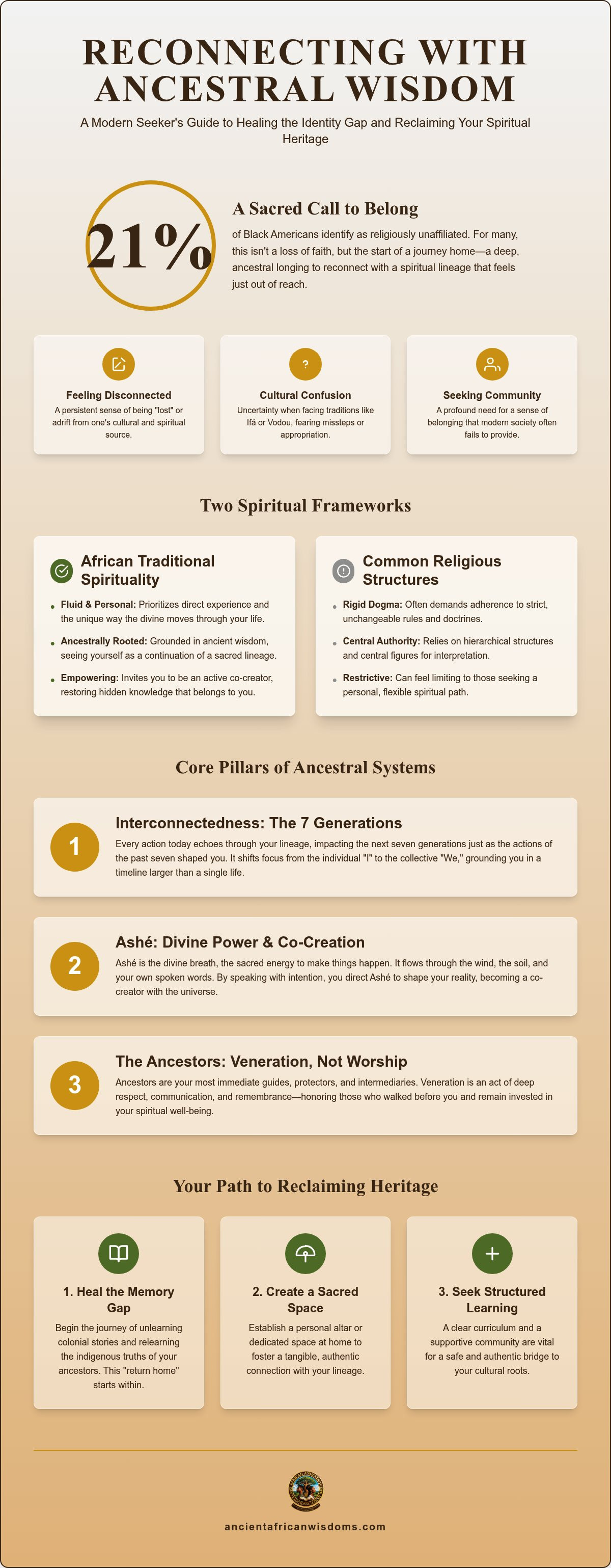
To reclaim your heritage, you must first understand the invisible architecture that supports it. These systems aren't just collections of beliefs; they're ways of being that connect the physical world with the unseen. Central to African diaspora identity and spirituality is a worldview where everything is interconnected. Every action you take today echoes through your lineage, impacting the next seven generations just as the actions of those seven generations ago shaped your current reality. This perspective shifts your focus from the individual "I" to the collective "we," grounding you in a timeline that is much larger than a single lifespan.
Understanding Ashé as Divine Power
Ashé is the divine breath, the essential power to make things happen in the world. It's the sacred energy that flows through the wind, the soil, and your own spoken words. When you speak with clear intention, you're directing Ashé to shape your reality. This recognition brings a deep ethical responsibility. You aren't just a passive observer of life; you're a co-creator with the universe. Cultivating your personal power requires aligning your daily actions with ancestral truth. If you're looking for a structured way to deepen this alignment, you might consider exploring ancestral spiritual teachings to guide your practice.
The Role of the Ancestors
Ancestors serve as your most immediate intermediaries and protectors. They're the wise guides who have walked the path before you and remain deeply invested in your success and spiritual well-being. It's vital to understand the distinction between ancestor worship and ancestral veneration for the African diaspora. Veneration is an act of respect and communication, not the replacement of a higher creator. It's a way to keep the lines of communication open with those who share your blood and spirit.
As many scholars noted in discussions on the spirituality of Africa, these indigenous systems are pluralistic and remarkably resilient. Your DNA carries more than just physical traits; it holds the spiritual codes and the memory of thousands of people who survived and thrived so that you could exist today. By honoring them, you're essentially honoring the strongest, most authentic parts of yourself. This practice provides a sense of safety and continuity that can heal the displacement often felt in the diaspora.
Navigating the Diverse Traditions of the Diaspora
The landscape of African-derived traditions is vast and can feel overwhelming at first glance. You might hear names like Ifá, Santería, Lucumí, or Candomblé and wonder where you fit in. While these traditions developed in different geographic pockets, they share a singular, powerful core. They're various branches of the same ancient tree, rooted in the soil of the African continent. Understanding African diaspora identity and spirituality requires looking past the regional labels to see the universal truths that unite us all. You don't need to choose a specific label today to begin your journey of reclamation.
West African Origins and Global Iterations
Most of these traditions trace their lineages back to the Yoruba, Igbo, and Akan peoples of West Africa. These systems didn't just survive the Middle Passage; they adapted and thrived in new environments. In the Americas, Yoruba traditions evolved into Santería, while Igbo practices like Odinani maintained their essence through communal memory and oral tradition. You'll find a striking "family resemblance" in rituals across the Atlantic, from the way offerings are presented to the rhythmic patterns of the drums. This continuity is a testament to the resilience of our ancestors. Much of the LSU research on Afro-spirituality highlights how these practices served as vital tools for navigating identity and preserving cultural dignity in the face of erasure.
Finding Your Specific Resonance
It's common to feel a "call" toward a specific lineage, but don't feel pressured to rush into a commitment. Your spiritual journey is a marathon, not a sprint. While your intuition is a powerful compass, it must be balanced with authentic education. In our modern world, it's easy to fall into the trap of "pop" spirituality or commercialized rituals that lack depth. Avoid the temptation of "tradition-hopping," where you take bits and pieces from various systems without ever committing to the discipline of one. This approach often leads to confusion rather than clarity.
True reclamation comes from deep, structured study. You don't need to be an initiate to begin honoring your roots in a meaningful way. Start by listening to your own internal guidance and seeking out mentors who act as bridge-builders rather than gatekeepers. By focusing on the foundational principles first, you create a safe harbor for your growth. This steady approach ensures your practice is both authentic and sustainable, allowing your African diaspora identity and spirituality to bloom with integrity and purpose.
Practical Steps for Reclaiming Your Spiritual Heritage
Reclaiming your roots doesn't require a complex initiation or a massive lifestyle overhaul. It begins with the quiet, intentional act of making space in your heart and home for those who came before you. This practical approach to African diaspora identity and spirituality allows you to build a foundation that is both sustainable and deeply personal. You're building a bridge across time, and every small action you take serves as a stone in that structure.
Start by setting your intention. In our previous discussion of Ashé, we learned that the spoken word has the power to shape reality. Take a moment each morning to state your desire to reconnect with your lineage. Your ancestors are listening. This simple declaration acts as a beacon for their guidance and aligns your internal compass with your heritage.
Building Your First Ancestral Altar
Your altar is a physical focal point for communication and reverence. It doesn't need to be elaborate or expensive. Find a clean, quiet surface in your home and place these three essential elements to begin:
- Cool, fresh water: A clear glass of water represents life, clarity, and a welcoming environment for spirits.
- Light: A simple white candle symbolizes the presence of the divine and the illumination of your path.
- Photographs: Include images of known ancestors who lived honorable lives. If you don't have photos, you can write their names on a clean piece of paper.
Maintain this space with high reverence. Keep it free of dust and clutter, as this cleanliness reflects the clarity of your mind and the respect you hold for your lineage. Use this altar as a place to sit in silence, share your thoughts, and listen for the quiet whispers of ancestral wisdom.
Daily Rituals for Spiritual Grounding
Use morning libations to ground yourself before the day begins. Pour a small amount of water from your glass into a potted plant or onto the earth while acknowledging your ancestors by name or as a collective. This act of giving back to the source strengthens your spiritual muscle and reminds you of your place within the larger framework of African diaspora identity and spirituality. Even in a busy, modern lifestyle, taking five minutes for prayer or meditation at your altar can align your daily actions with ancestral truth.
As your curiosity grows, you'll likely feel a pull toward more structured learning. Moving from general exploration to a disciplined curriculum provides the safety and depth needed for true spiritual growth. If you're ready to take that next step, you can explore the African Ancestral Traditional School Levels to begin your formal journey toward authenticity and community connection.
Structured Learning: The Bridge to Authenticity
While starting a personal practice at home is a beautiful first step, many soon find that "DIY" spirituality has its limits. Without a steady hand to guide you, it's easy to feel overwhelmed by the vastness of the traditions or confused by conflicting information found online. This is where African diaspora identity and spirituality moves from a solitary search into a communal and disciplined path of growth. True reclamation isn't just about collecting facts; it's about a deep, internal transformation that requires a structured environment.
The African Ancestral Traditional School serves as a safe harbor for those seeking this depth. By offering tiered digital courses on African culture and rituals, the school provides a clear, methodical progression that honors the sacredness of the teachings. These tiered learning levels act as a bridge, helping you move from a place of curiosity to a state of grounded, authentic practice. You're never left to wonder if you're "doing it wrong" because the curriculum is designed to support your spiritual safety and success every step of the way.
Why a Structured Curriculum is Essential
Order is a fundamental principle in ancestral wisdom. Protecting the sacredness of this knowledge requires a progression that respects the depth of the teachings. When you choose a formal path, you're opting for a framework that prevents the confusion often found in unguided exploration. You can learn more about how to select African diaspora spiritual growth programs to see how they provide the necessary structure for your development. Information alone won't change your life, but a curriculum facilitates the true spiritual transformation that occurs when knowledge is applied with discipline and reverence.
Walking this path with others is equally important. Community access allows you to share experiences and find support among fellow seekers who are also reclaiming their roots. This collective energy reinforces your individual journey, reminding you that you're part of a larger, living movement of restoration. It provides a sense of belonging that is essential for a healthy African diaspora identity and spirituality.
Your Invitation to the Journey
The journey from a curious seeker to a grounded practitioner is one of the most rewarding paths you can take. Reclaiming your identity offers long-term benefits that extend into every area of your life, providing a sense of peace, purpose, and personal power. You're no longer drifting without an anchor; you're rooted in a lineage that stretches back thousands of years. This connection provides a spiritual safety that modern life simply cannot offer.
Take the first step with quiet confidence. Your ancestors have been waiting for your return, and the path is now open for you to walk. Whether you're just starting to set your intention or you're ready for deep, structured study, know that you're supported by those who came before you. Reclaiming your heritage is more than a religious choice; it's a sacred act of restoring your wholeness and stepping into the fullness of who you were always meant to be.
Stepping into Your Ancestral Power
You've walked through the sacred landscape of your heritage, from the divine power of Ashé to the practical steps of building your first altar. Reclaiming your African diaspora identity and spirituality is a profound act of restoration that heals the deep identity gap left by history. By honoring your ancestors through daily veneration and understanding the interconnectedness of the seven generations, you transform from a curious seeker into a grounded practitioner. This journey isn't just about learning facts. It's about reclaiming the peace and power that have always belonged to you.
True growth occurs when you move from solitary exploration into a structured environment that respects the sacredness of the traditions. We offer a tiered digital curriculum and a global community of diaspora seekers focused on authentic, grounded rituals. You don't have to walk this path alone. Begin your journey of reclamation with our structured ancestral spiritual teachings. Your ancestors have been waiting for this moment, and your return to the source is the fulfillment of their legacy.
Frequently Asked Questions
How is African diaspora spirituality different from traditional religion?
African diaspora spirituality prioritizes a living connection with the divine rather than adhering to rigid institutional dogmas. While traditional religion often relies on centralized authority and fixed texts, these ancestral paths focus on personal agency and direct experience. It's a fluid way of being that honors the rhythm of nature and the whispers of your lineage. This approach allows you to build a practice that feels both ancient and relevant to your modern reality.
Do I need to be initiated in person to practice ancestral veneration?
You don't need a formal in-person initiation to begin the sacred practice of ancestral veneration. Veneration is essentially an act of respect and communication that you can perform in the privacy of your own home. It's about opening a dialogue with those who share your blood and spirit. While deep study is valuable, the foundational act of honoring those who came before you is a birthright that requires only a sincere heart and a clear intention.
What is the first thing a beginner should do to reconnect with their roots?
The first step is to state your intention clearly and create a small, dedicated space for reflection. You can begin by placing a clean glass of fresh water and a white candle on a quiet surface in your home. This simple act signals your readiness to reconnect with your heritage. Take a few moments each day to sit in silence at this spot, acknowledging your ancestors and asking for their guidance as you begin your journey.
Can I practice these traditions if I don’t know exactly which part of Africa my family is from?
You can absolutely practice these traditions even if your specific geographic origins remain unknown. Your African diaspora identity and spirituality are rooted in a shared consciousness that transcends modern borders. Your DNA carries the spiritual codes of thousands of ancestors who survived and thrived. By focusing on the universal principles of African cosmology, you tap into a collective wisdom that is always accessible to you, regardless of your specific tribal or regional data.
What is the role of an ancestral altar in modern spiritual practice?
An ancestral altar serves as a physical focal point and a bridge between the material and spiritual realms in your daily life. It provides a grounded space where you can pause, offer gratitude, and seek clarity from your lineage. In a busy modern world, this sacred corner acts as a sanctuary for your spirit. It's a place where you can consistently nourish your connection to the unseen, making your spiritual heritage a living part of your household.
Is it possible to learn authentic African rituals through online courses?
You can certainly learn authentic rituals through structured digital learning platforms. Online courses provide an accessible and safe harbor for seekers who may not have access to local mentors or traditional communities. By following a disciplined curriculum, you gain the foundational knowledge needed to practice with integrity and confidence. This structured approach ensures that you're unlearning distortions and relearning the truths of your ancestors in a way that is respectful and sustainable.
How does reclaiming my spiritual identity help my mental well-being?
Reclaiming your spiritual identity heals the persistent "identity gap" that often leads to feelings of displacement and fragmentation. When you reconnect with your roots, you gain a profound sense of belonging and a clearer understanding of your purpose. This restoration of cultural memory provides a sturdy foundation for your mental well-being. It replaces confusion with the quiet confidence that comes from knowing you're a vital continuation of an honorable and powerful lineage.
What are the tiered levels in the African Ancestral Traditional School?
The school provides tiered learning levels designed to guide you through a methodical progression of knowledge and practice. These levels start with foundational teachings on African diaspora identity and spirituality and move toward more advanced understandings of rituals and cosmology. This structured path ensures that your growth is disciplined and safe. Each level builds upon the previous one, allowing you to deepen your connection to your heritage while walking alongside a supportive community of global students.


