
Have you ever felt a deep, quiet pull toward your roots, only to be stopped by the fear that you might be betraying your current faith? This hesitation often arises from a fundamental misunderstanding of ancestor veneration vs worship. Many seekers worry that by pouring a libation or speaking a name, they're elevating a human relative to the status of a deity. This confusion creates a barrier that keeps you disconnected from the strength of your lineage, leaving you feeling adrift in a world that often forgets its past.
It's natural to feel cautious when you've been taught that certain traditions are forbidden or dangerous. You want to honor your history while maintaining your spiritual integrity and safety. In this guide, you'll discover the sacred distinction between honoring your lineage and religious worship to reclaim your African spiritual identity with clarity. We'll dismantle the myths surrounding these practices and offer a practical framework for you to begin your journey of reclamation. You'll learn how to approach your heritage with reverence and find the permission you've been seeking to finally come home to yourself.
Key Takeaways
- Clarify the distinction between ancestor veneration vs worship to remove the fear of spiritual repercussion and reclaim your heritage.
- Learn how ancestors act as sacred intermediaries within African cosmology, maintaining the balance between the physical and spiritual realms.
- Establish a practical, respectful foundation for honoring your bloodline using focused intention rather than elaborate tools.
- Move beyond the spiritual static of the internet by embracing a structured path of learning that protects your cultural identity.
- Gain the spiritual confidence to bridge the gap between your modern life and the ancient wisdom of your lineage.
The Misunderstood Language of Ancestral Connection
The word "worship" carries a specific, heavy resonance in Western society. For many, it implies the total surrender of one's soul to a supreme deity. When you begin to explore your African roots, this word often becomes a stumbling block, creating a sense of spiritual conflict. You might wonder if you're crossing a line that shouldn't be crossed. However, the tension between ancestor veneration vs worship is often a product of language rather than spiritual reality. Veneration is not about creating new gods; it's about acknowledging the living bridge of your own bloodline.
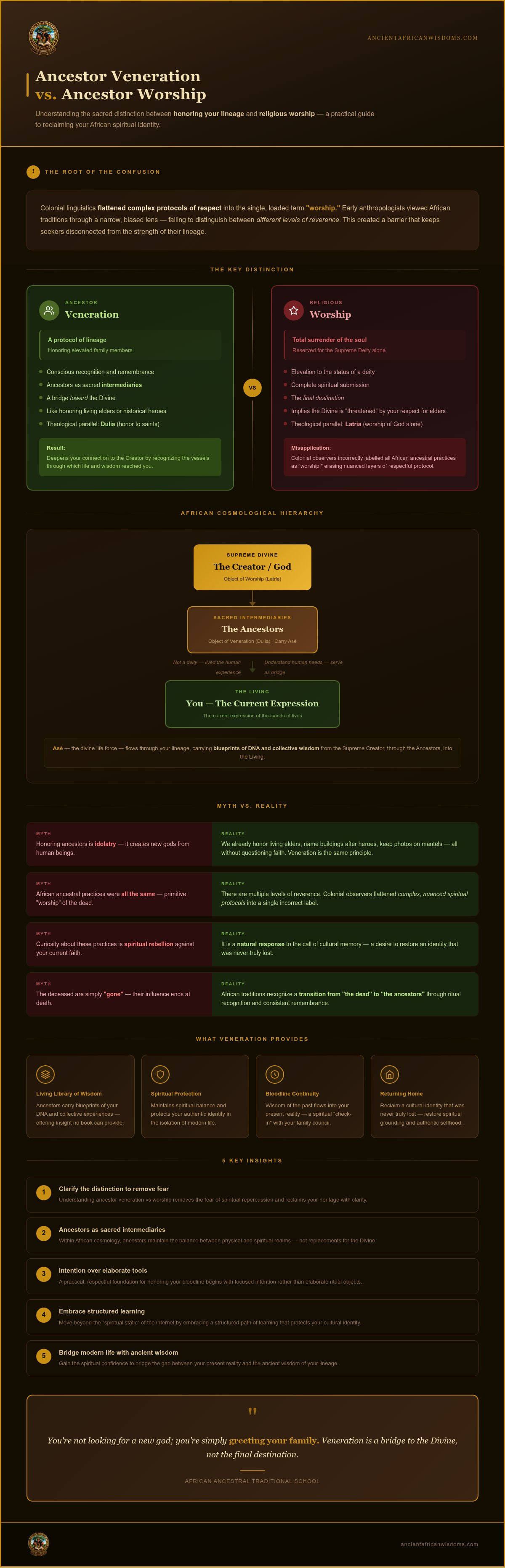
Colonial linguistics played a significant role in this confusion. In an effort to simplify and categorize African traditions, early observers flattened complex protocols of respect into the singular, loaded term "worship." They missed the subtle layers of how we interact with the seen and unseen. Your curiosity about these practices isn't a sign of spiritual rebellion. It is a natural response to the call of your cultural memory, a desire to restore an identity that was never truly lost. You're simply learning the language of your own heritage.
Myth vs. Reality: Is it Idolatry?
Many fear that honoring those who came before them is a form of idolatry. This fear suggests that the Divine Creator is somehow threatened by the love you show your grandmother or a great-grandfather you never met. In reality, we honor living elders and historical heroes every day without questioning our faith. We name buildings after them and keep their photos on our mantels. Veneration is a bridge to the Divine, not the final destination. It serves as a way to acknowledge the vessels through which life and wisdom reached you. By recognizing the source, you actually deepen your connection to the Creator.
The Origin of the Confusion
The roots of this misunderstanding lie with early anthropologists who viewed indigenous practices through a narrow, biased lens. They often failed to distinguish between different levels of reverence. This is similar to the theological concepts of Latria, which is the worship reserved for God alone, and Dulia, which is the honor given to saints or spirits. You can find more context on how these terms have been applied globally in this Ancestor Worship Overview. By viewing your ancestors as elevated family members rather than deities, you reclaim the right to honor your lineage with a clear heart and a peaceful mind. You're not looking for a new god; you're simply greeting your family.
Defining Veneration: The Protocol of Lineage
Veneration is a precise protocol of lineage, and understanding its nature is the first step in clarifying the debate of ancestor veneration vs worship. It represents the conscious decision to move beyond mere mourning and into a state of active recognition. While the Western world often views the deceased as "gone," African traditions recognize a transition from the status of "the dead" to the status of "the ancestors." This transition happens through ritual recognition and consistent remembrance. Without this connection, we become spiritual orphans, disconnected from the very roots that provide our stability and strength.
Maintaining bloodline continuity is essential for spiritual balance. You aren't just an individual; you're the current expression of thousands of lives. When you engage in veneration, you're performing a spiritual "checking in" with your family council. This practice ensures that the wisdom of the past flows into your present reality, keeping you grounded in your authentic identity. It's an act of remembering that protects you from the isolation of modern life.
Understanding Asè and Ancestral Power
To understand how this connection works, we must look at the concept of Asè. This is the divine life force that permeates all things and flows directly through your lineage. Understanding the asè meaning is vital because it informs how we communicate with those who came before us. Your ancestors aren't distant shadows; they're the "living library" of your family’s specific wisdom and resilience. They carry the blueprints of your DNA and the collective experiences of your people, offering a depth of insight that no book can provide.
The Ancestral Intermediary
A common point of confusion in the discussion of ancestor veneration vs worship is the role ancestors play in the spiritual hierarchy. They're not replacements for the Divine. Instead, they act as intermediaries who understand the human condition because they lived it. There is a clear theological distinction between veneration and worship that we must respect to maintain clarity on our path.
Ancestors don't grant miracles through their own power. They advocate for you and guide you according to divine law. Think of them as experienced elders who have a seat at the table of the family council. They know your struggles and your potential better than anyone else. By speaking with them, you're seeking guidance from those who are deeply invested in your success. If you're ready to deepen this connection, you can explore our ancestral spiritual teachings to find a structured path forward.
Worship vs. Veneration: A Theological Distinction
To find true spiritual clarity, we must look at the fundamental intention behind our actions. When we examine the concept of ancestor veneration vs worship, we're looking at two distinct spiritual frequencies that serve different purposes in your life. Worship is an act of total submission to the Supreme Being, the singular Source of all existence. Veneration, conversely, is an act of honor directed toward those who walked the path before you. In the African worldview, the power dynamic is clear: God is the Source, while the ancestors serve as the messengers and advocates who bridge the gap between human needs and divine laws.
Think of it as the difference between a citizen’s relationship with a high court and their relationship with their own parents. You owe your life to the Creator, but you owe your specific identity and physical presence to your lineage. You aren't replacing the Divine when you light a candle for your lineage. You're actually honoring the Creator’s handiwork by respecting the very people the Divine used to bring you into this world. This understanding removes the weight of guilt and allows you to approach your roots with a peaceful heart.
Key Differences in Ritual and Intent
The language we use reveals our deep-seated intent. We pray to the Divine for the salvation of our souls or the governance of the cosmos. We talk to our ancestors about the daily realities of life, such as family stability, health, and career direction. This distinction extends to our physical actions. While sacrifice often implies atonement for sin in a Western religious context, an offering in ancestral tradition is a gesture of hospitality. It's much like setting a plate for a respected guest who has returned home.
The spaces we inhabit also reflect this difference. Worship often takes place in communal temples or is directed toward the vastness of the universe. Veneration is more intimate, usually centered in the home or at a family altar. It's a private, familial protocol that maintains the warmth of the household and the strength of the bloodline.
The Role of the Creator in African Spirituality
Many seekers are surprised to learn that African spiritual healing is rooted in a deeply monotheistic understanding of the universe. The Great Divine is viewed as an infinite, vast presence that governs all things. Because this power is so immense and all-encompassing, it can feel distant to the human experience. The ancestors act as vital intermediaries who translate our specific, human concerns into the language of the spirit. They don't intercept the glory of the Creator; they facilitate a more structured and accessible path toward the Divine. By honoring your lineage, you're simply following the natural order of the universe as it was intended.
Practical Veneration: Honoring the Bloodline Safely
Reclaiming your identity is more than a mental shift; it's a lived experience that takes root in your daily environment. To truly grasp the difference between ancestor veneration vs worship, you must move from theory into practice. This journey doesn't require a temple or complex religious conversion. It begins with the simple, grounded intention to remember those who paved the way for your existence. By creating a physical point of contact in your home, you transform an abstract concept into a tangible relationship that provides strength and clarity.
It's vital to focus on the concept of the "Elevated Ancestor." Not every relative who passes away automatically becomes an ancestor in the spiritual sense. We focus our energy on those who lived with integrity and left a positive legacy for the family. This discernment is what keeps your practice safe and empowering. Your first ritual is often found in genealogy. Researching your family tree and collecting oral histories turns "the dead" into recognized family members. Knowing their names and stories is the foundation of true veneration.
Creating a Sacred Space at Home
You don't need expensive tools to begin. A small, clean surface in a quiet corner of your home is enough. For specific steps on how to arrange these items, you can follow our African ancestral altar setup guide. Use simple symbols like a glass of fresh water to represent life and clarity, a candle to focus your attention, and photos to anchor your memories. A "Daily Greeting" is a powerful way to integrate this into a modern schedule. Spend a few moments each morning acknowledging their presence; it's a simple act of respect that maintains the warmth of the connection without the pressure of religious dogma.
Communication and Offerings
A common hurdle in understanding ancestor veneration vs worship is the idea of offerings. In African tradition, ancestors "eat" the essence and vibration of your intention rather than the physical matter. An offering is a gesture of hospitality, much like offering a seat to a respected guest. You can use simple, non-religious affirmations to speak your truth. Tell them about your goals, your fears, and your gratitude. Communication is a two-way street, so practice listening for guidance. This often comes through quiet intuition or sudden synchronicities in your daily life. If you're ready to move beyond basic steps and seek a deeper connection, you can explore our ancestral spiritual teachings to build a more structured and mentored practice.
Reclaiming Your Heritage through Structured Learning
The initial spark of curiosity is a beautiful thing. It's the moment your soul begins to stir, recognizing a call from deep within your lineage. However, trying to piece together a spiritual practice from the vast, unvetted corners of the internet often leads to what we call "spiritual static." You might find fragments of truth, but without a cohesive framework, these pieces can create more confusion than clarity. This is especially true when exploring the nuanced relationship of ancestor veneration vs worship. Without a steady hand to guide you, the fear of doing something "wrong" can stall your progress before you truly begin.
The African Ancestral Traditional School exists to be that steady hand. We act as humble custodians of tradition, providing you with a structured path that honors the weight and sacredness of your heritage. Moving from a curious beginner to a confident practitioner requires more than just information; it requires a mentored environment where you feel safe to ask questions and explore your roots. By following a deliberate, rhythmic progression, you ensure that your connection to your ancestors is built on a foundation of authenticity rather than guesswork.
The Levels of Ancestral Wisdom
Our curriculum is designed to meet you exactly where you are. The school’s tiered levels provide a safe environment for exploring African ancestral rituals online. This tiered approach is essential because it allows you to build your "spiritual muscles" gradually. Just as a seedling needs the right balance of soil and light to grow, your spiritual practice needs the right structure to flourish without being overwhelmed by esoteric concepts too early. We focus on authentic tradition that remains accessible to modern life, ensuring you don't feel judged as you bridge the gap between your current reality and your historical roots. At the introductory stages, there's no requirement for in-person initiation; instead, the focus is on your internal development and familial recognition.
Take the Next Step in Your Journey
You've spent time unlearning the myths and understanding the theological distinctions. Now, it's time to move from "myth-busting" to "active practice." Understanding the sacred distinction of ancestor veneration vs worship is just the beginning of a lifelong journey of reclamation. Reclaiming your heritage is a profound act of love for yourself and those who came before you. It's not a cause for fear, but a journey toward a deep sense of belonging and spiritual safety. We invite you to explore our ancestral spiritual teachings and join a community of like-minded seekers in the diaspora. Your ancestors are waiting for you to find your way home, and we're here to help you walk that journey with confidence and grace.
Step into Your Authentic Spiritual Identity
You now possess the clarity to see that the distinction between ancestor veneration vs worship is a matter of sacred protocol and familial love. By recognizing your ancestors as honored intermediaries rather than divine replacements, you can finally release the hesitation that has kept you from your heritage. This journey is about restoration and the quiet confidence that comes from knowing exactly where you stand in your lineage.
True reclamation requires more than just information; it demands a safe, community-oriented learning environment where tradition is protected. Our school provides a structured digital curriculum designed to help the African Diaspora navigate this path with grace. You don't have to walk this road alone or rely on unvetted fragments of knowledge found online. We offer authentic ancestral spiritual teachings that act as a steady hand for your internal growth.
Explore the Levels of the African Ancestral Traditional School
Your ancestors are the living library of your family's strength. Reclaiming your connection to them is a profound act of self-love that brings balance to your modern life. Take this next step with a peaceful heart, knowing you're simply finding your way back home.
Frequently Asked Questions
Is ancestor veneration the same as praying to the dead?
Veneration is a formal recognition of your bloodline rather than a religious prayer for the salvation of the deceased. While you may speak to them, you're engaging with them as living extensions of your family's wisdom and strength. It's more like a conversation with a respected elder than a petition to a deity. This distinction is at the heart of ancestor veneration vs worship, ensuring you honor your roots safely.
Can I practice ancestor veneration if I am a Christian or Muslim?
You can absolutely honor your lineage while maintaining your current religious identity. Many people in the diaspora find that veneration complements their faith by grounding them in their human history. It's a cultural practice of family loyalty and filial piety. You aren't replacing your God; you're simply acknowledging the bridge that brought you here. This approach allows you to reclaim your African spiritual identity with profound clarity and internal peace.
What is the difference between a deity and an ancestor?
The primary difference lies in the source of power and the scope of influence. A deity is viewed as a universal creator or a cosmic force that governs all existence. An ancestor is an elevated human relative who understands your specific DNA and human struggles. Ancestors act as messengers who advocate for you within the divine order. They don't have god-like powers but serve as a wise family council in the spirit realm.
Do I have to "worship" ancestors I didn’t know or didn’t like?
You are never required to honor ancestors who caused harm or lived without integrity. In African tradition, we specifically focus on Elevated Ancestors who lived well and left a positive legacy. Veneration is an act of love and respect, so you should only connect with those who offer strength. You can acknowledge the bloodline generally without inviting the influence of specific individuals whose character or actions you don't respect.
What happens if I don’t venerate my ancestors?
Choosing not to venerate doesn't result in punishment, but it can lead to a sense of spiritual orphanhood. Without this connection, you may feel disconnected from your roots and lack the grounding that comes from ancestral support. Veneration provides a sense of belonging and intergenerational resilience. By stepping away from this protocol, you're simply missing out on the wisdom and protection that your lineage naturally provides for your life.
How do I know if my ancestors are actually hearing me?
You'll often recognize their presence through quiet intuition or sudden synchronicities in your daily life. They may communicate through vivid dreams or a persistent sense of knowing that guides your decisions. While the response isn't always immediate or loud, the results of their guidance manifest as increased clarity and a smoother path forward. Trusting your internal development is a key part of learning how to listen for their subtle, protective voices.
Is an ancestral altar the same as an idol?
An ancestral altar is a sacred focal point for memory rather than an object of worship. It serves as a physical anchor for your intention and a place to honor your heritage. Using photos, water, and candles helps you concentrate your energy and show respect to your lineage. This practice clarifies the theological distinction of ancestor veneration vs worship, where the altar acts as a bridge to your family rather than a substitute for the Divine.
What is the first step for a beginner in ancestor veneration?
The most effective first step is researching your genealogy and gathering oral histories from living elders. Knowing the names and stories of your predecessors turns abstract concepts into real family members. You can then begin a simple daily greeting, perhaps by placing a glass of fresh water in a quiet corner. For those seeking more guidance, our structured school levels provide a safe, mentored way to learn authentic rituals without needing in-person initiation.


