
What if the persistent feeling of being adrift isn't a personal flaw, but a soul deep invitation to finally come home? For many seekers within the global diaspora, the journey of learning African traditional spirituality feels like trying to assemble a sacred mirror from shattered pieces scattered across a vast, often contradictory digital landscape. You likely feel the weight of your lineage calling to you in quiet moments, yet you're held back by a valid fear of doing it wrong or accidentally disrespecting the very traditions you wish to honor. It's exhausting to navigate fragmented information when all you truly desire is a clear, authentic connection to your roots.
You deserve a path that respects the gravity of this wisdom while remaining accessible to your modern life. We understand that reclaiming your heritage is a delicate process of restoration, not just a study of facts. This guide provides the steady hand you've been looking for, offering a structured and reverent starting point for your growth. You'll discover how to cultivate a profound sense of spiritual belonging and learn practical, everyday ways to honor your ancestors with confidence and grace.
Key Takeaways
- Shift your perspective by viewing indigenous wisdom as a complete worldview that integrates the sacred into every aspect of your daily existence.
- Establish a secure foundation for learning African traditional spirituality by following a structured path that replaces confusion with clarity and cultural respect.
- Clarify the role of ancestors as intermediaries and protectors, moving beyond common myths toward a practice of authentic veneration and spiritual connection.
- Implement a practical five-step framework to begin your journey, emphasizing the importance of dedicated study before engaging in ritual practices.
- Access a supportive digital community and tiered educational levels designed specifically to guide the modern diaspora back to their ancestral home.
What Does It Mean to Begin Learning African Traditional Spirituality?
To begin learning African traditional spirituality is to step into a way of existing that predates modern definitions of faith. It isn't a collection of dogmas you must memorize or a set of rigid rules to follow. Instead, it's a comprehensive worldview that informs how you interact with the land, your community, and your own history. For those in the diaspora, this process is often described as a reclamation. You aren't learning something foreign; you're remembering a heritage that was silenced but never fully erased. It's a journey home to a self that has always existed beneath the surface of modern life.
While Western organized religions often operate through centralized institutions and written scriptures, indigenous African practices are decentralized and deeply personal. A foundational understanding of Traditional African religions reveals that these systems are diverse, yet they share a common thread of honoring the interconnectedness of all life. Approaching this sacred knowledge requires a high degree of reverence and intentionality. You're entering a conversation with the past, and that dialogue demands patience, humility, and a willing heart.
Spirituality vs. Religion: A Living Connection
In many African contexts, there is no word for religion because the spiritual is not separate from the secular. It's woven into the rhythm of daily life, from the way a meal is prepared to the manner in which a community settles a dispute. You won't find a single "holy book" to guide you. Instead, the primary scriptures are found in the movements of nature, the wisdom of oral traditions, and the lived experiences of the community. As you commit to learning African traditional spirituality, you'll find that your path is unique to your specific bloodline.
Your lineage serves as your primary spiritual authority. This shifts the focus from external leaders to the internal wisdom of your own ancestors. This connection is living and breathing; it's a constant exchange of energy that sustains both the living and those who have transitioned. By recognizing this, you move away from being a passive observer and become an active participant in your spiritual destiny.
The Call of the Ancestors
Many people begin this journey because they feel a persistent, unexplained pull toward their roots. You might experience vivid dreams, frequent synchronicities, or a sudden, intense curiosity about your family history. These aren't coincidences. They are invitations. Seeking knowledge is the first step of ancestral veneration for the African diaspora, as it signals to your lineage that you're ready to listen and learn.
The soul-call is a biological and spiritual nudge that pulls you toward the wisdom of those who came before you.
The Core Pillars of African Ancestral Wisdom
Learning African traditional spirituality requires an understanding of a sophisticated and intentional spiritual architecture. At the apex sits a Supreme Being, often viewed as a singular source of all existence who remains beyond human comprehension. This source delegates the management of the universe to a hierarchy of deities, spirits, and forces that govern the natural world. It's a tiered system of divine governance where every element has its place. Between the divine and the human world stand the ancestors, the elevated dead who remain actively invested in the success and health of their descendants. They act as intermediaries, offering a steady hand of protection to those who maintain a respectful connection through their bloodline.
A central pillar of this wisdom is the belief that life is a continuous, unbroken circle. The living, the dead, and the unborn are all part of a single community. Your actions today echo through this circle, affecting those who came before you and those yet to arrive. This leads to the essential concept of Iwa, or character. In these traditions, spiritual growth is measured by the quality of your character and your contribution to the collective well-being. Good character aligns you with the natural order, while poor character creates discord that ripples through your lineage. You're encouraged to view your spiritual development as a lifelong commitment to integrity and community harmony.
Understanding Asè: The Divine Life Force
Central to this worldview is the concept of asè meaning the power to make things happen. It is the divine life force that permeates every atom of existence, from the words you speak to the rhythms of the natural world. When you engage in rituals or simple daily acknowledgments, you're learning to tap into and direct this energy with precision. Harvard research on African spirituality highlights how these traditions utilize specific practices to manifest healing and alignment within this energy field. By refining your intentions, you learn to move in harmony with this force rather than struggling against the current of your own life.
The Significance of Lineage and Heritage
Your bloodline is the bridge that connects you to a vast reservoir of ancestral power. Knowing your "root" provides the grounding necessary to navigate the complexities of modern existence without feeling lost. This indigenous knowledge is preserved through cultural memory and indigenous knowledge, ensuring that the wisdom of the elders remains accessible even across great distances. You don't need to stand on African soil to honor your heritage. Your African bloodline is a portable temple that travels with you wherever you go. If you feel ready to explore these connections more deeply, you might consider beginning your journey with structured ancestral spiritual teachings that honor your specific path and pace.
Debunking Common Myths and Misconceptions
One of the biggest hurdles in learning African traditional spirituality is unlearning the sensationalized images often projected by popular media. Hollywood has frequently reduced complex, sacred systems like Vodou or Ifá to mere "dark magic" or caricatures of rituals. These portrayals ignore the profound ethical frameworks and philosophical depth found within these traditions. In reality, these practices focus on maintaining equilibrium between the individual and the cosmos. They aren't about power over others. Instead, they center on the refinement of self and the restoration of balance.
This historical suppression was intentional. Colonial narratives labeled indigenous beliefs as "primitive" or "evil" to justify the dismantling of African social structures and maintain control. By reclaiming these truths, you're participating in an act of spiritual decolonization. You'll find that these ancient ways are remarkably compatible with modern logic. Many traditions rely on precise observations of the natural world, similar to scientific inquiry, to understand the rhythms of life and health. These systems survived for millennia because they are functional, practical, and deeply rooted in the reality of the human condition.
Ancestor Veneration vs. Worship
A common point of confusion for beginners is the distinction between veneration and worship. Within an African worldview, worship is reserved for the Supreme Being or high divine forces. Veneration is simply the act of honoring and respecting those who paved the way for your existence. Think of your lineage like a massive family tree. You don't worship the roots that sustain the tree. You acknowledge that without them, the leaves cannot thrive. Honoring your ancestors is a way of acknowledging the very DNA that allows you to breathe today. It's an act of profound gratitude, not idolatry.
The "Evil" Label: Unpacking Colonial Bias
The label of "evil" was a tool used to erase identity. When you look past these biases, you discover that authentic practices are rooted in healing, protection, and the strengthening of the collective. Research into the role of community in African spirituality shows that these traditions prioritize the restoration of harmony within families and society. Don't let external dogmas dictate your spiritual safety. As you explore your heritage, trust your internal sense of peace. If a practice brings you closer to your truth and fosters a sense of belonging, it's serving its sacred purpose. Authenticity always feels like a return to wholeness.
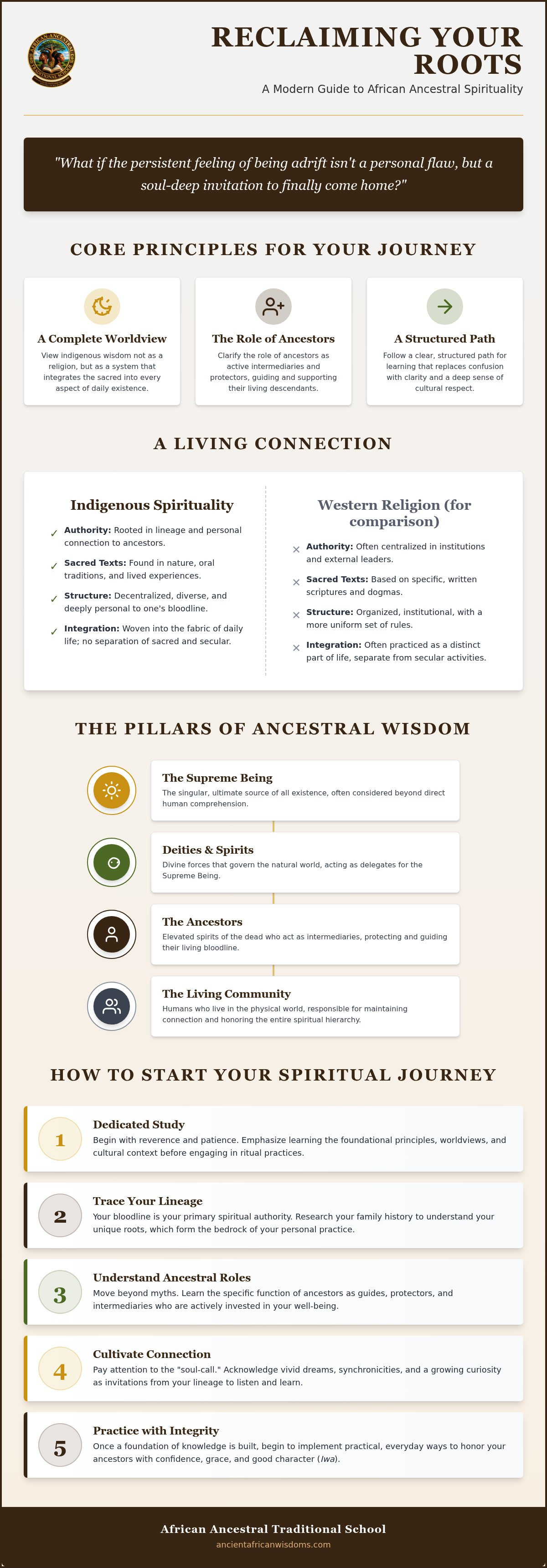
How to Start Your Spiritual Journey: A 5-Step Framework
Beginning the process of learning African traditional spirituality is a methodical return to a path your ancestors already walked. It doesn't require immediate perfection or complex ceremonies. Instead, it demands a sincere heart and a structured approach. This framework provides a steady hand for the modern seeker, ensuring you build your foundation on solid ground rather than fragmented internet rumors. By following these steps, you move from a place of disconnection to a position of grounded authority within your own lineage.
- Step 1: Dedicate yourself to study. Knowledge must always precede practice. Before you light a single candle, seek to understand the cosmology and ethics of the tradition you're exploring.
- Step 2: Begin simple ancestral acknowledgments. You can start in the privacy of your own home. A glass of fresh water and a moment of silent gratitude are powerful ways to signal your readiness to connect.
- Step 3: Connect with a reputable online school for African traditions. Digital platforms now bridge the gap between ancient wisdom and the global diaspora, making authentic teachings accessible regardless of where you live.
- Step 4: Join a community of seekers. You weren't meant to navigate this reclamation in isolation. Finding a group of like-minded individuals provides the emotional safety and support needed for long-term growth.
- Step 5: Practice patience. Spiritual development is a lifelong rhythm, not a race. Allow the wisdom to settle into your bones at its own pace.
Setting Up a Sacred Space for Learning
Creating a dedicated area in your home serves as a physical anchor for your internal journey. This doesn't need to be elaborate; a simple, quiet corner can act as a classroom for the soul. Within this space, you can engage with African ancestral rituals online, which provide clear guidance for establishing a respectful home practice. Remember that physical items are always secondary to your intention. Your heart is the primary altar where the real work of reconnection happens, and a focused environment helps you listen more clearly to the whispers of your heritage.
Finding Authentic Mentorship
A wise teacher acts as a bridge builder, helping you navigate the nuances of tradition with humility and lineage awareness. When seeking guidance, look for a structured African spiritual learning environment that offers a clear, tiered curriculum. Be cautious of those who demand large sums for "instant" power or secret initiations. Authentic growth is disciplined and nurturing, never rushed or high-pressure. If you're ready to take the next step with a steady hand to guide you, you can explore our ancestral spiritual teachings to find a community that honors your path.
Advancing Your Path with the African Ancestral Traditional School
Taking the first step toward your roots is a profound act of courage, but sustaining that momentum requires more than just curiosity. While the initial "soul-call" provides the spark, the African Ancestral Traditional School offers the fuel for a lifelong fire. We provide a series of tiered online levels specifically designed to meet the needs of the modern diaspora. These African ancestral spirituality courses bridge the gap between ancient, indigenous wisdom and the digital accessibility of our current age. You don't have to navigate this transition alone or wonder if you're interpreting signs correctly; instead, you can rely on a steady hand to guide your progression.
Our school provides a safe, structured environment for those who seek truth without the weight of rigid dogma. We focus on digital education and community, ensuring that the path of learning African traditional spirituality remains respectful and grounded in authentic tradition. This isn't about a quick fix or a superficial connection. It's about a methodical, reverent return to the wisdom that has always belonged to you.
Structured Learning vs. Fragmented Research
In the digital era, it's easy to fall into the trap of "cherry-picking" spiritual practices from social media or unverified sources. This fragmented approach often leads to confusion or a lack of spiritual depth. A formal curriculum ensures that you build a solid foundation before attempting more complex tasks. Our levels move you methodically from basic cultural awareness to the understanding of deep spiritual rituals. Each stage of learning African traditional spirituality is intentional, ensuring that your growth is both safe and sustainable. You wouldn't build a house without a blueprint, and your spiritual home deserves the same level of care and structural integrity.
Joining a Global Community of Seekers
Isolation is one of the greatest challenges for those reclaiming their heritage. When you're the only one in your immediate circle pursuing this path, the journey can feel lonely or even daunting. This is why our African diaspora online learning community is so vital. It provides a space for peer support, shared reflection, and collective growth. By securing an African spiritual community membership, you gain access to a sanctuary of truth and a network of like-minded seekers. You're part of a global movement of reclamation that is healing lineages across every continent. Together, we are restoring the lost threads of our collective identity and weaving them into a vibrant, purposeful future.
Embrace Your Ancestral Calling
Reclaiming your heritage is a journey of restoration that begins with a single, intentional step. You've explored how these traditions offer a complete worldview, grounding you in the knowledge that your lineage is a living source of guidance and protection. By moving past colonial myths and embracing a structured framework, you transform the fragmented pieces of your history into a solid foundation for growth. This process isn't just about acquiring facts; it's about answering a deep internal call to belong to something timeless and sacred.
Learning African traditional spirituality requires a steady hand and a supportive environment. You don't have to navigate this path in isolation. Our school provides ancient wisdom for modern life through a structured curriculum and a safe, reverent online community designed specifically for the global diaspora. We invite you to move beyond curiosity and step into the disciplined, nurturing space your spiritual well-being deserves.
Begin your journey today by exploring our School Levels. Your ancestors have been waiting for this moment of reconnection. Trust the rhythm of your own growth and know that you are finally coming home.
Frequently Asked Questions
Is it possible to learn African traditional spirituality online?
Yes, learning African traditional spirituality is entirely possible through digital platforms that provide a structured curriculum and community support. The African Ancestral Traditional School delivers its full program online. This allows the global diaspora to reconnect with their roots regardless of their physical location. This approach ensures that ancient wisdom remains accessible and relevant to modern lives while maintaining the reverence required for authentic spiritual development.
Do I need to be initiated into a specific tradition to start learning?
You don't need to be initiated to begin your education; dedicated study should always come first. Our school focuses on providing ancestral spiritual teachings that build a foundation of knowledge before any ritual practice begins. While we don't offer in-person initiation ceremonies, we provide the structured learning necessary for you to understand your heritage. This allows you to connect with your lineage with confidence and respect from the very beginning.
What is the first thing I should do to honor my ancestors?
The simplest and most effective first step is to offer a glass of fresh water and a moment of silent gratitude. This basic act signals your readiness to listen. It honors the life force that flows through your bloodline. You don't need elaborate tools to begin your journey. Sincerity and consistency are far more valuable than physical items when you're first reaching out to those who came before you.
Can I practice African spirituality if I also belong to a church?
Many seekers find that African traditional spirituality serves as a cultural worldview that can coexist with their existing faith. Because these practices are rooted in lineage and character rather than exclusive dogma, they often provide a deeper sense of identity that complements other spiritual paths. It's about reclaiming a heritage that was once silenced. This allows you to bridge the gap between your current reality and your historical roots without feeling forced to choose.
How do I know if the information I find online about African traditions is authentic?
Authenticity is usually marked by a structured curriculum, a focus on character, and a clear respect for lineage. Be cautious of sources that demand large sums for "instant power" or focus solely on sensationalized rituals. Reputable programs prioritize steady growth, community support, and the restoration of lost knowledge. Look for mentors who act as bridge builders and offer a disciplined, nurturing environment for your long term spiritual success.
What are the different levels of learning in the African Ancestral Traditional School?
Our school utilizes tiered levels designed to guide you through a logical progression of growth. While learning African traditional spirituality, you'll start with fundamental cultural awareness and slowly advance toward more complex ancestral spiritual teachings and rituals. Each level builds upon the previous one. This ensures you have a solid foundation before moving deeper into the tradition. This structured approach prevents the overwhelm that often comes from fragmented research.
Are there any specific rituals I can start doing as a beginner?
Beginners can start with simple ancestral acknowledgments and the creation of a dedicated space for quiet study. Setting aside a specific corner in your home for reflection helps anchor your intention. It provides a classroom for the soul. You might also engage with basic digital courses on African culture to ground your practice in historical truth. These small, consistent actions build the spiritual discipline required for more advanced work later.
Why is character (Iwa) so important in African spiritual teachings?
Character, or Iwa, is the foundation of your spiritual development because it determines your alignment with the natural order. In these traditions, your growth is measured by your integrity and your contribution to the collective well-being. Good character ensures that your actions create harmony rather than discord within your lineage. It's the most essential requirement for anyone seeking to walk this path with authenticity and power.


