
What if the connection you've been searching for isn't found in a distant past, but within the very rhythm of your breath? Many people today feel a profound sense of displacement, as if a vital cord to their lineage has been severed by time and distance. You might feel a quiet longing to honor those who came before you, yet find yourself hesitant, perhaps confused by the difference between sacred veneration and religious worship. Integrating daily African ancestral rituals into your life isn't about performing complex ceremonies or adopting a life that feels foreign to your current reality. It's about reclaiming a spiritual identity that has always belonged to you, providing a grounded foundation for your modern journey.
In this guide, you'll discover how to weave these ancient traditions into a peaceful daily routine that fosters deep spiritual safety. We'll walk through the specific, respectful steps to build your own ancestral altar and clarify how to seek guidance without overwhelm. By the end of this journey, you'll have a structured practice that transforms your home into a sanctuary of heritage and purpose. Let's begin the process of restorative learning together, bridging the gap between who you are today and the vast, enduring strength of your ancestors.
Key Takeaways
- Understand how daily African ancestral rituals serve as intentional acts of communication that ground your spiritual identity in the modern world.
- Explore the concept of Asè and learn how your ancestors act as vital intermediaries between the physical and spiritual realms.
- Navigate the distinction between honoring your lineage and religious worship to find spiritual harmony with your existing beliefs.
- Master a practical five-step process to establish a sacred space and maintain a consistent, respectful ritual practice in your home.
- Discover how structured digital education through the African Ancestral Traditional School provides a clear, mentor-led path for your long-term spiritual growth.
What Are Daily African Ancestral Rituals?
Daily African ancestral rituals are best understood as sacred, intentional acts of communication. They aren't mere habits or empty gestures; they're rhythmic moments where you pause to honor the lineage that flows through your veins. By engaging in these practices, you acknowledge that your ancestors aren't distant historical figures or names on a dusty tree. They're living spirits who remain deeply invested in your well-being and growth. These rituals serve as a vital anchor for your spiritual identity, helping you maintain a sense of balance in a world that often feels chaotic and disconnected. Ancestor veneration is the deliberate practice of honoring those who came before us to receive their guidance and cultivate ancestral wisdom for our current lives.
The Core Purpose of Daily Practice
When you commit to a daily practice, you establish a steady pulse of connection to your heritage. This rhythm creates a sanctuary of spiritual safety that follows you throughout your day. It offers a grounding force that keeps you steady when life's pressures mount or when you feel overwhelmed by the noise of modern society. You'll find that these moments of reflection allow you to navigate modern challenges using the timeless insights of those who survived and thrived long before you. You're never truly alone when you walk with the strength of your lineage behind you. It's about building a foundation of peace and clarity that informs every decision you make.
Rituals as a Bridge for the Diaspora
For those in the diaspora, daily African ancestral rituals act as a powerful tool for reclamation and healing. History may have obscured specific names, languages, or regional details, but your spirit remembers the connection. Intentionality is far more important than achieving regional perfection in your movements or prayers. Your ancestors respond to the sincerity of your heart and the consistency of your effort rather than the complexity of your tools. This journey of reconnection is a key part of spiritual self-mastery in African traditions, where you learn to harness your internal power through the wisdom of your roots. By reclaiming these practices, you begin to heal the fractures of the past and build a whole, authentic identity for the future. It's a way to turn historical loss into a present-day victory of the spirit.
The Philosophy of Ancestral Connection and Asè
The heart of this practice lies in understanding Asè, the divine energy that flows through all of existence. It is the life force that breathes through the trees, the rivers, and your own lungs. In the framework of Traditional African Religion, your ancestors are the primary custodians of this energy within your lineage. They serve as vital intermediaries, bridging the gap between the physical world you inhabit and the vast spiritual realms. They are not distant memories. They are active, living spirits who possess the wisdom of their lived experiences and the clarity of their current spiritual state. This connection ensures that you are never truly navigating life's complexities in isolation.
Understanding the Power of Asè
Asè is the power to make things happen. It is the authority behind your intentions and the strength within your words. When you perform daily African ancestral rituals, you are doing more than just remembering the past. You are actively cultivating and refining your personal Asè. This daily engagement acts like a spiritual discipline, allowing you to direct your energy with precision and grace. By aligning your will with the guidance of your ancestors, you tap into a reservoir of power that transcends your individual effort. This partnership empowers you to face modern challenges with a calm, ancient confidence that is both felt and seen by those around you.
The Lineage of Wisdom
Your lineage is a tapestry woven from both blood ancestors and the spiritual or cultural elders who shaped your world. You carry their victories and their lessons within your very being. Upholding ancestral truths is a sacred responsibility that asks you to live an exemplary life. How you conduct yourself today determines the quality of the legacy you leave for those who will one day call you an ancestor. This continuity of life is a source of immense strength, reminding you that your existence is part of a much larger, purposeful story. To help navigate these deep waters, a traditional African wisdom school provides the structured curriculum needed to decode these ancient philosophies for modern application.
Believing that your ancestors are with us now is not a metaphor; it is a lived reality that offers spiritual sovereignty. They are the silent pillars of support standing behind you in every moment of doubt. By integrating daily African ancestral rituals into your schedule, you transform your routine into a living prayer of reclamation. If you're seeking a structured path to honor this connection, you might consider how to access our ancestral spiritual teachings to further your journey. By embracing this philosophy, you transform your daily life into a living sanctuary of power.
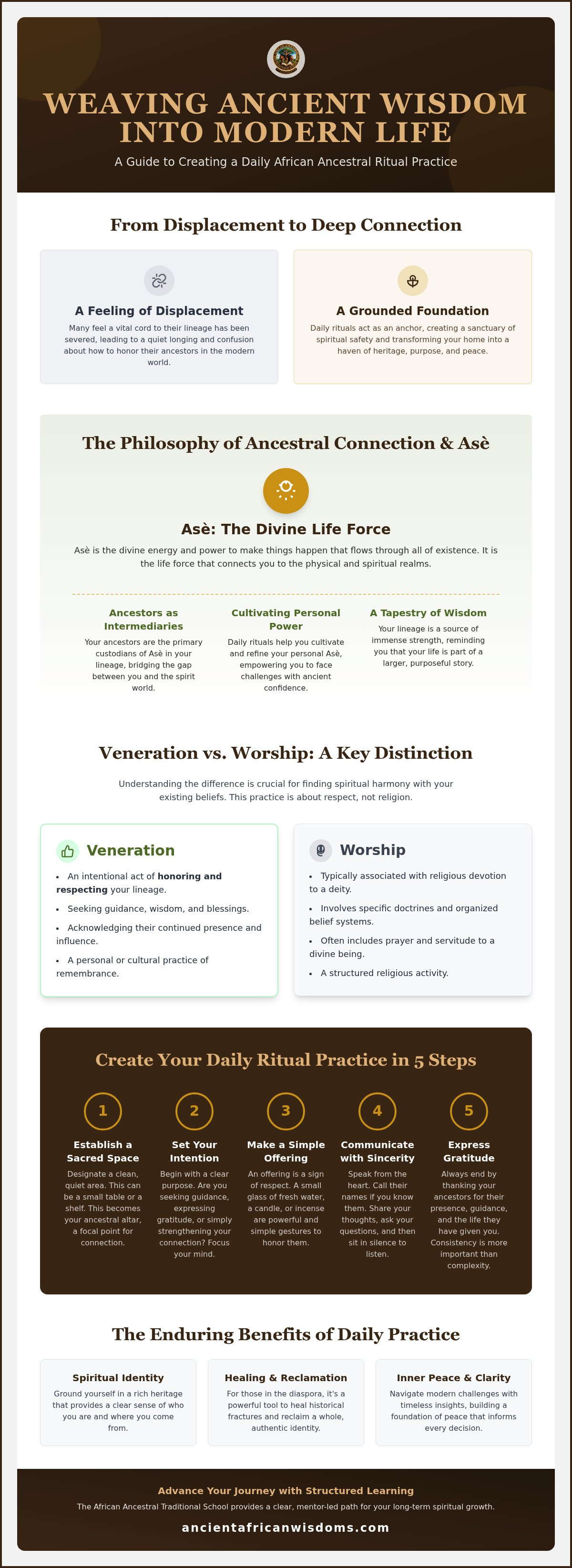
Veneration vs. Worship: Addressing Common Misconceptions
Many seekers hesitate to begin their journey because of a single, nagging question: "Am I worshipping my ancestors?" This confusion is often fueled by centuries of external narratives that have mislabeled sacred traditions. To move forward with confidence, you must understand the clear boundary between veneration and worship. In African spiritual frameworks, there is almost always a recognition of a Supreme Creator. Ancestors are not deified as replacements for this ultimate source. Instead, they are honored as elevated elders who continue to guide their families from the spiritual realm. They are your spiritual intermediaries, not your gods.
Western media has historically portrayed these practices as "pagan" or "superstitious," creating a stigma that many in the diaspora still carry. These myths suggest that daily African ancestral rituals are a form of idol worship. In truth, these acts are about maintaining a living connection with your history. When you pour water or speak a name, you are acknowledging the continuity of life. You are saying, "I see you, I remember you, and I value the wisdom you left behind."
Defining Veneration in African Tradition
Veneration is best described as a deep, soulful respect. It's the same type of reverence you would show a living grandmother who holds the stories of your people. You wouldn't say you "worship" her, but you certainly honor her presence and seek her counsel. Ancestors serve as the guardians of the community's moral compass. By engaging in daily African ancestral rituals, you are simply keeping the door open for that guidance to flow into your modern life. It is an act of family loyalty that spans the veil between worlds.
Navigating Religious Syncretism
It's entirely possible to find spiritual harmony between your ancestral roots and your current religious path. Many practitioners around the world successfully blend these rituals with monotheistic faiths like Christianity or Islam. They view these practices as a vital form of cultural preservation rather than a religious replacement. Your lineage is your biological and spiritual inheritance; honoring it doesn't have to contradict your devotion to a higher power. Instead, it enriches your identity, providing a grounded sense of who you are and where you come from. Understanding this traditional philosophy allows you to reclaim your heritage without the weight of guilt or fear.
How to Create Your Daily Ritual Practice
Starting a practice of daily African ancestral rituals doesn't require a hidden temple or a massive financial investment. It requires your focus and your heart. Many people feel overwhelmed by the idea of getting everything perfect, but your ancestors value the sincerity of your effort more than the price of your tools. By following a structured approach, you can transform a small corner of your home into a powerful site of reconnection and peace. This process is about building a bridge of consistency that grows stronger every time you show up.
Setting Up Your Ancestral Altar
Your first step is to designate a sacred space. Choose a clean, quiet location in your home where you won't be easily disturbed. This could be a small table, a shelf, or even the top of a dresser. Begin by covering the surface with a clean white cloth to signify purity and clarity. Place a clear glass of fresh, cool water at the center, as water is the universal conduit for spiritual energy. Add a single white candle to represent the light of guidance. If you have them, you may add photographs of your deceased loved ones or small items that belonged to them. If you don't have photos, symbols that represent your heritage or even a simple stone from the earth can serve as a focal point for your intentions.
The Daily Morning Ritual
Morning is the ideal time to greet your lineage before the noise of the world takes hold. Approach your altar with a calm mind and light the candle. Speak to your ancestors as you would to respected elders, offering a simple greeting and acknowledging their presence in your life. This is the moment for the libation. Pouring fresh water into a bowl or onto the earth serves as a cooling offering that honors the vital life force of your ancestors. As you pour, call out the names of those you remember, and invite the "unknown ancestors" to also receive your respect. State your intentions for the day clearly, asking for their protection, wisdom, and clarity as you move through your tasks.
Evening Reflection and Closing
At the end of your day, return to your altar for a few moments of quiet gratitude. Reflect on the events of the day and acknowledge any moments where you felt a sense of guidance or inner strength. This practice helps you recognize the subtle ways your daily African ancestral rituals are impacting your reality. Thank your ancestors for their continued presence before you extinguish the candle. Keep the space physically clean and change the water daily to ensure the energy remains fresh and inviting. If you're ready to deepen this practice under guided mentorship, you can explore our specific spiritual rituals and digital courses to further your journey.
Advancing Your Journey with Structured Learning
Establishing a foundation through daily African ancestral rituals is a powerful first step toward spiritual reclamation. Once you've felt the grounding energy of these practices, you might find yourself yearning for a deeper, more comprehensive understanding of your heritage. While simple acts of reverence provide immediate peace, a structured spiritual education offers the tools needed for long-term growth and cultural sovereignty. The African Ancestral Traditional School acts as a dedicated mentor for those ready to move beyond the basics. It provides a safe, structured environment for the diaspora to reclaim authentic traditions in a way that respects the depth of history while remaining relevant to your current life.
The Benefits of Level-Based Learning
A structured curriculum is vital for anyone who wants to avoid the confusion that often results from scattered, informal information. By moving through tiered school levels, you ensure that your foundational knowledge is unshakable before you approach more advanced ancestral teachings. This progressive path mirrors a traditional way of learning, allowing you to absorb ancient insights at a pace that is both natural and sustainable. Digital courses are particularly well-suited for a modern lifestyle, as they allow you to engage with profound spiritual concepts without having to pause your daily responsibilities. You aren't just collecting information; you're participating in a deliberate process of internal development and self-discovery.
Joining the Ancestral Wisdom Community
Reclaiming a lost identity is a significant undertaking, and it's a journey that's best shared with others who understand its weight. Joining a global community of students offers a sense of belonging and spiritual safety that solitary practice often lacks. Within this digital space, you can connect with like-minded seekers who are also navigating the complexities of ancestral connection in the modern world. Mentorship is a cornerstone of this experience, providing a steady hand to help you decode cultural truths and apply them to your reality. This community-oriented approach ensures that you're supported as you restore hidden knowledge and build a future rooted in authenticity. If you're ready to deepen your commitment to daily African ancestral rituals and move toward mastery, you can Explore the African Ancestral Traditional School Levels to begin your structured path today.
Your Path to Ancestral Reclamation
Reclaiming your heritage is a journey of steady, intentional steps. By integrating daily African ancestral rituals into your life, you've begun to bridge the gap between your modern reality and your ancient roots. You now understand that veneration is a soulful act of respect rather than a religious conflict. You possess the practical tools to maintain a sacred space that honors your lineage. This connection offers more than just peace; it provides a grounded sense of spiritual identity that empowers every decision you make.
If you feel called to deepen this connection, you don't have to navigate the path alone. Begin your journey in our African Ancestral Traditional School. We provide a structured curriculum specifically designed for the diaspora within a safe, digital learning environment. Here, you'll join a global community of traditional seekers dedicated to restoring lost knowledge and living with authenticity. Your ancestors are waiting to walk beside you. Take the next step toward your spiritual sovereignty today.
Common Questions About Ancestral Rituals
Is practicing ancestral rituals a form of magic or witchcraft?
No, these practices are not magic or witchcraft in the way Western media often portrays them. They are sacred acts of family loyalty and respect. While some traditions use spiritual tools, the core of daily African ancestral rituals is about communication and continuity. You are simply talking to your elders who have passed on. It is a natural extension of loving your family and honoring the roots that gave you life today.
Can I honor my ancestors if I do not know my specific lineage?
You absolutely can honor your ancestors even if your specific lineage was lost to history. Your DNA carries the memory of every person who came before you, and their spirits recognize your call. You can address them as "my known and unknown ancestors" or "those who walk with me." Sincerity and the intention to reconnect are far more important than having a perfectly documented family tree or specific regional names.
Do I need to be initiated to start a daily ancestral ritual?
You don't need to be initiated to begin a daily practice of reverence. Honoring your lineage is a fundamental birthright that belongs to every human being. While some advanced roles within a community might require specific training, the simple act of pouring water and speaking to your elders is open to everyone. You can start exactly where you are today by creating a small, respectful space in your home to begin your journey.
What should I do if my family does not approve of my ancestral practice?
Spiritual safety is paramount, so it's perfectly acceptable to keep your practice private if your family isn't supportive. You can maintain a "hidden" altar or simply perform your daily African ancestral rituals through quiet meditation and internal prayer. Your ancestors understand the complexities of modern family dynamics and the need for peace. They value your safety and the quiet devotion of your heart over a public display that causes unnecessary conflict.
How often should I clean or reset my ancestral altar?
You should change the water on your altar every single day to keep the energy fresh and inviting. A deeper cleaning of the white cloth and the physical space can be done once a week or whenever you feel the energy has become stagnant. Maintaining a tidy altar reflects the respect you have for your lineage. It ensures that your sacred space remains a clear and vibrant conduit for the peaceful guidance you seek.
Can I perform these rituals if I am also a practicing Christian or Muslim?
Many people successfully balance their ancestral traditions with their Christian or Muslim faith. These rituals are often viewed as a form of cultural preservation and familial respect rather than a religious replacement. Since ancestors are seen as intermediaries and elders rather than deities, honoring them doesn't have to conflict with your worship of a Supreme Creator. It's about recognizing that your spiritual identity has room for both your faith and your historical roots.
What happens if I miss a day of my ritual practice?
Your ancestors are patient and compassionate, so nothing negative happens if you miss a day of your practice. Life is often busy, and they understand the challenges you face in the physical world. Simply return to your altar when you're able and resume your rhythm with a sincere heart. The goal is consistency over time, not a perfect record of performance. What matters most is your ongoing commitment to the relationship.
Is it necessary to use specific African languages during my prayers?
It isn't necessary to speak a specific African language to be heard by your ancestors. They understand the language of your heart and the sincerity behind your words, regardless of the tongue you use. While learning traditional phrases can be a beautiful way to reclaim your culture, your prayers are just as effective in English. Use the words that feel most natural to you so that your communication remains authentic, clear, and deeply personal.


