
What if the feeling of being a "spiritual orphan" isn't a permanent condition, but a call from your ancestors to finally come home? It's common to feel a sense of loss when your lineage feels like a series of broken threads, especially when so much modern spirituality feels commercialized or hollow. You're likely looking for something deeper than a trend; you're looking for the truth of who you are and where you belong. This guide promises to help you bridge that distance by introducing a structured African diaspora self-discovery course designed for the modern seeker.
We'll walk through a clear, level-based path of spiritual reclamation that moves beyond theory and into lived experience. You'll discover how to build your first ancestral altar, learn the rhythms of daily veneration, and find your place within a global community of seekers. Together, we'll explore how to transform your modern life into a sanctuary of ancient wisdom and authentic connection. This journey is about more than just history; it's about the restoration of your internal power and the reclamation of your sacred identity.
Key Takeaways
- Recognize that reclaiming your identity requires more than academic study; it calls for a spiritual "re-membering" of lost ancestral connections.
- Identify the core pillars of lineage and Asè to ensure your path is rooted in authentic divine life force and historical continuity.
- Evaluate any African diaspora self-discovery course by looking for a structured, tiered progression that leads to internal transformation rather than just information.
- Learn the practical steps for building an ancestral altar and performing daily veneration to bridge the gap between your modern world and your roots.
- Discover how digital learning creates a valid, sacred bridge for the global diaspora to access traditional wisdom from anywhere in the world.
Why Self-Discovery for the African Diaspora Starts with Ancestral Wisdom
Many people within the African diaspora experience a pull toward something they cannot quite name. It's a quiet whisper from the blood, a sense that there's a deeper layer to their identity than what is found in modern, secular life. True self-discovery in this context isn't just about finding yourself; it's about "re-membering" the spiritual connections that were intentionally severed. While academic study provides a map, an African diaspora self-discovery course offers the actual journey. It provides the spiritual grounding necessary to turn abstract heritage into a living foundation. Without this grounded approach, the search for identity often feels like wandering through a thick fog without a compass.
The Difference Between Knowing History and Living Tradition
History often feels like a collection of distant events, but tradition is a living, breathing continuity. You can memorize the dates of significant arrivals or the names of lost civilizations without ever feeling the pulse of your ancestors in your daily life. Ancestral spiritual teachings bridge the gap between the displacement of 1619 and the reality of your life today. This isn't just about information retention. It's about cultural memory acting as a catalyst for modern self-actualization. When you live the tradition, you move from being a spectator of history to an active participant in your lineage. You begin to understand that you aren't starting from zero; you're continuing a story that began long before you were born.
Addressing the 'Soul-Void' of Displacement
Have you ever felt a persistent, internal "unsettledness" that doesn't go away with success or travel? This is the soul-void caused by cultural displacement. It's the feeling of being a spiritual orphan even when you know your immediate family tree. Reclaiming your African spiritual identity serves as a profound form of psychological and spiritual healing. It addresses the root of that orphan-feeling by re-establishing your place in a vast, unbroken chain. Ancestral reclamation is the restoration of hidden sacred knowledge. By engaging with a structured path, you move through this deep work with a steady hand to guide you. This process replaces confusion with clarity and a sense of belonging that no textbook can provide. A structured course offers the discipline and nurturing needed to heal these old wounds safely.
Core Pillars of an Authentic Diaspora Reclamation Program
Building a bridge back to your roots requires more than just reading books. While academic departments like Indiana University's African American and African Diaspora Studies provide vital historical frameworks, a true African diaspora self-discovery course must reach into the metaphysical realm. It requires a structure built on pillars that have sustained our ancestors through every trial. These pillars move you from being a student of history to a practitioner of culture. Choosing an African diaspora self-discovery course that emphasizes these pillars ensures your growth is both sacred and sustainable.
The first pillar is lineage. You aren't an isolated individual; you're a link in an unbroken chain. Recognizing this chain changes how you view your daily struggles and successes. The second pillar is the concept of Asè. This divine life force is the power to manifest change and speak truth into existence. Learning to cultivate your Asè is essential for internal alignment. Finally, ancestral veneration and community provide the active and collective environment needed for this growth. Self-discovery is often framed as a solo journey in Western thought, but in African traditions, we heal together. You need the mirrors provided by fellow seekers to see yourself clearly.
Lineage and the Reclamation of Identity
Many seekers start with a generic sense of being "African." While this is a good beginning, deeper work involves moving toward specific ancestral connections. Reclaiming your identity means adopting the names, concepts, and worldviews that were once hidden. By learning African traditional spirituality, you gain a clear framework for this lineage work. It allows you to step out of a modern, fragmented self and into a whole, historical identity. This process is about more than just data; it's about the restoration of your spiritual authority.
Practical Rituals for Modern Seekers
Theory alone cannot bridge the gap between your current reality and your history. An authentic program must include practical application. The ancestral altar serves as the focal point for this self-discovery. It isn't just a decoration; it's a "spiritual technology" designed to facilitate communication between realms. Through daily rituals, you learn to listen to the wisdom of those who walked before you. These practices offer a grounded way to integrate sacredness into your modern schedule. If you feel ready to move beyond study and into practice, you can start your journey today with a community that understands your path.
Academic History vs. Spiritual Self-Discovery Courses
Many seekers find themselves at a crossroads between the library and the altar. Choosing the right path depends entirely on what you hope to achieve at the end of your study. Are you looking for a certificate to hang on a wall, or a change you can feel in your very bones? An academic approach focuses primarily on information retention. You learn about the vast movements of people and the complex geopolitical shifts that shaped our history. However, an African diaspora self-discovery course aims for something deeper: spiritual transformation. It moves beyond the intellect to help you find true internal alignment with your ancestors. Information is a vital tool, but transformation is the ultimate goal for the displaced soul.
The environment of learning also differs significantly between these two paths. A traditional classroom is designed for objective analysis and critical distance. In contrast, a sacred learning community fosters subjective experience and spiritual intimacy. We need a hybrid approach that respects both history and spirit. You must understand the physical journey of those who came before you to appreciate the spiritual resilience they passed down. Integrating these two perspectives allows you to move through the modern world with a sharp mind and a grounded, ancient soul.
When to Choose an Academic Path
Academic programs are ideal if you're seeking career credentials or specific social science expertise. For example, the African Diaspora and the World program at Spelman College provides a rigorous framework for understanding global contributions. It's a necessary foundation for those who want to teach, research, or work in policy. These courses excel at explaining dates, migrations, and external cultural impacts. Yet, a university setting often has limitations in providing personal spiritual guidance. It can tell you what happened to your ancestors, but it rarely teaches you how to speak with them or hear their guidance in your own life.
When a Spiritual Course is Essential
A spiritual course becomes essential when your primary question is: "Who am I in the eyes of my ancestors?" This path focuses on internal development and the active cultivation of Asè. You aren't just learning about rituals as a bystander; you're learning to perform them as a practitioner. The online school for African traditions serves as a model for this type of sacred education. It offers a structured environment where the goal is internal peace and ancestral communication. This path is for the seeker who wants to bridge the gap between historical facts and a living, breathing relationship with their heritage.
A Framework for Evaluating Your Path of Spiritual Education
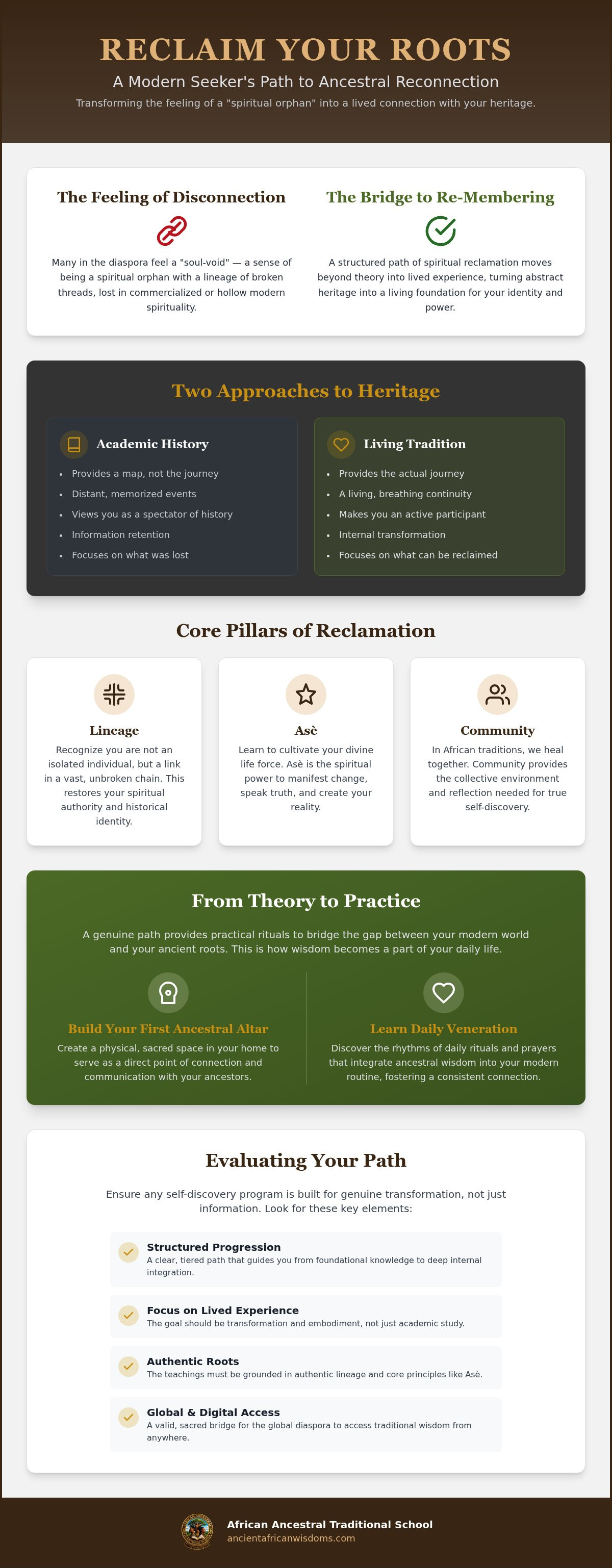
Choosing an African diaspora self-discovery course is a significant step in your reclamation journey. It's not just about signing up for a class; it's about finding a sacred space where your soul can breathe and grow. To find a path that is both authentic and effective, you need a clear framework for evaluation. Start by checking for lineage. Is the teacher or school rooted in a recognized tradition, or are they presenting a commercialized version of spirituality? Authenticity is the foundation of everything that follows. You aren't just looking for information; you're looking for a connection to a living source.
Next, evaluate the structure of the program. A path that offers tiered levels for progressive growth is often more sustainable than a one-size-fits-all workshop. You also want to look for community. Will you be learning in isolation, or will you have a tribe of fellow seekers to walk with you? Finally, assess the practicality and tone of the education. An authentic course should teach you how to practice at home through ritual and veneration, and it should do so with a tone that feels reverent, grounded, and respectful of the ancestors. If the program feels rushed or high-pressure, it likely isn't the steady hand you need.
Vetting Your Spiritual Mentorship Online
In the digital age, finding a guide you can trust is more important than ever. You don't have to travel across the globe to find wisdom, but you do need to be discerning. Avoid programs that use high-pressure sales tactics or promise "instant" initiations without any cultural context. These are often red flags that the program prioritizes profit over the sacredness of the work. Engaging with African cultural spirituality online requires a higher standard of ethics to protect both the tradition and the student. Look for mentors who position themselves as humble custodians rather than mystical gurus. A true teacher is a bridge-builder, not a gatekeeper.
The Power of Tiered Learning Levels
True spiritual growth cannot be rushed or consumed in a single session. It's a process of internal development that unfolds over time. Tiered learning levels provide a psychological benefit by giving you a clear sense of progression and achievement. These levels mirror the traditional stages of maturity in African societies, where knowledge is shared according to a person's readiness and growth. This structure prevents you from feeling overwhelmed and ensures that you build a solid foundation before moving into more advanced ancestral rituals. If you're ready to find a path that respects your pace and your potential, you can explore our level-based curriculum and find where you belong.
Reclaiming Your Heritage through the African Ancestral Traditional School
The search for identity often leads to many doors, but few offer a key that fits your specific modern reality. The African Ancestral Traditional School was born from the need to provide a sacred, structured space for this very purpose. Our mission is to offer an accessible path for those who feel the call of their lineage but don't know where to start. By offering an African diaspora self-discovery course that is 100% digital, we remove the barriers of geography and physical travel. You don't need to visit a specific campus to begin your reclamation; the temple is built within your own home and heart.
Our curriculum is thoughtfully designed to move you through tiered levels of growth. This methodical pace ensures that you aren't just consuming information, but are instead undergoing a genuine spiritual shift. You'll start by grounding yourself in foundational cultural truths before advancing to the deeper work of ancestral rituals. This progression allows you to build your spiritual muscles slowly and surely. It transforms the act of seeking into a state of knowing, where your identity is no longer a question but a source of power. Digital learning is a valid, sacred bridge that honors your ancestors while respecting your current life.
A Structured Journey of Ancestral Connection
The digital curriculum we provide balances deep ancestral teachings with practical, modern application. We understand that you have a life to lead, a career to manage, and a family to care for. Because of this, our teachings are designed to integrate seamlessly into your current schedule. You'll learn how to recognize the flow of Asè in your environment and how to use it to manifest balance. This isn't about escaping your modern world; it's about infusing it with the sacredness that was always meant to be there. As you move through the school's levels, you'll find that your connection to the spirit world becomes a steady, guiding force.
Join the Global Movement of Spiritual Reclamation
One of the most profound benefits of this path is the realization that you are part of a global movement. When you engage with our African spiritual community membership, you connect with others who share your history and your hopes. This support system is vital for maintaining your practice and finding encouragement during difficult moments. Reclaiming your heritage is a collective act of pride and resistance against the void of displacement. We invite you to choose your first level of study today and step onto a path that leads back to your true self. Your ancestors are waiting for you to take that first step toward home.
Step into the Light of Your Ancestral Identity
Reclaiming your heritage is a journey that moves beyond the pages of a history book and into the very center of your soul. It's a shift from merely knowing what happened to your ancestors to actively living the traditions they fought to preserve. By focusing on the core pillars of lineage and Asè, you transform from a seeker into a practitioner who carries the light of their heritage with pride. Finding the right African diaspora self-discovery course is about finding a steady hand to guide you through this deep, transformative work.
You don't have to navigate this path in isolation. The African Ancestral Traditional School provides tiered learning levels for structured growth and access to a global community of diaspora seekers. These authentic teachings are grounded in ancestral wisdom and designed to fit into your modern life. Begin your journey of reclamation with the African Ancestral Traditional School today. Your ancestors have been calling you home for a long time; it's finally time to answer that call with confidence and peace.
Frequently Asked Questions
What is an African diaspora self-discovery course?
An African diaspora self-discovery course is a structured path designed to help you reconnect with your ancestral heritage through spiritual and cultural teachings. It moves beyond standard history by focusing on internal identity and the reclamation of sacred knowledge. This program provides a steady hand for those seeking to bridge the gap between their modern lives and their ancient roots. It's a journey of "re-membering" your place in a vast, unbroken chain of life and wisdom.
Can I really learn African traditional spirituality online?
You can absolutely learn these traditions online. Digital delivery serves as a sacred bridge for the global diaspora, especially for those who cannot travel to the continent. These courses provide authentic teachings on rituals and philosophy while maintaining deep respect for the tradition's weight. While the African Ancestral Traditional School doesn't offer in-person initiation ceremonies, the digital curriculum provides the foundational spiritual rituals needed to build a living relationship with your ancestors from your own home.
Do I need to know my specific ethnic lineage to start a course?
You don't need to know your specific ethnic group or have a detailed family tree to begin this journey. Many seekers start with a general sense of African identity and use the course to refine their connection. The curriculum provides a broad framework of ancestral wisdom that applies across many traditions. As you progress through the levels, you'll learn the tools to listen to your lineage and discover your specific ancestral path with clarity and peace.
How do these courses differ from academic Black Studies programs?
Academic programs are designed for information retention and intellectual analysis of history. In contrast, an African diaspora self-discovery course focuses on spiritual transformation and internal alignment. While academic study tells you what happened to the diaspora, these courses teach you how to live as a part of it. You'll move from being a student of history to a practitioner of culture, focusing on concepts like Asè and the practical application of ancestral rituals.
What are the 'levels' in the African Ancestral Traditional School?
The school uses tiered learning levels to provide a structured path for progressive growth. These levels guide you from foundational cultural wisdom in the beginning stages to more advanced ancestral spiritual teachings as you mature. This structure mirrors traditional African societies where knowledge is shared based on a person's readiness. It ensures you build a solid foundation of understanding before engaging in deeper ritual work, protecting your spiritual well-being throughout the entire developmental process.
Is ancestral veneration a religious practice or a cultural one?
Ancestral veneration is a cultural pillar that recognizes the continuity of the family line, but it's also a deeply spiritual practice. It's the act of maintaining a living relationship with those who walked before you. In African traditions, culture and spirit aren't separate; they're woven together. Veneration isn't about worshiping the dead. It's about honoring the wisdom and life force they passed down to you, ensuring their legacy continues through your daily actions and rituals.
How long does it take to complete a self-discovery program?
The time required depends on your individual pace and the specific level you're studying. Since true self-discovery is a lifelong journey, these programs aren't meant to be consumed in a single weekend. Most students find that moving through a level over several weeks or months allows the information to settle into their spirit. A methodical pace is encouraged because spiritual growth can't be rushed. It requires space for reflection, practice, and the integration of new wisdom.
Will I be able to connect with other students during the course?
Connection is a core part of the experience. You'll have community access to a global tribe of diaspora seekers who are walking a similar path. This collective environment provides the mirrors needed to see your own growth clearly. Sharing insights and experiences with others helps heal the sense of isolation that often follows cultural displacement. You'll find that your personal journey is strengthened by the warmth and support of a community that understands your sacred purpose.


